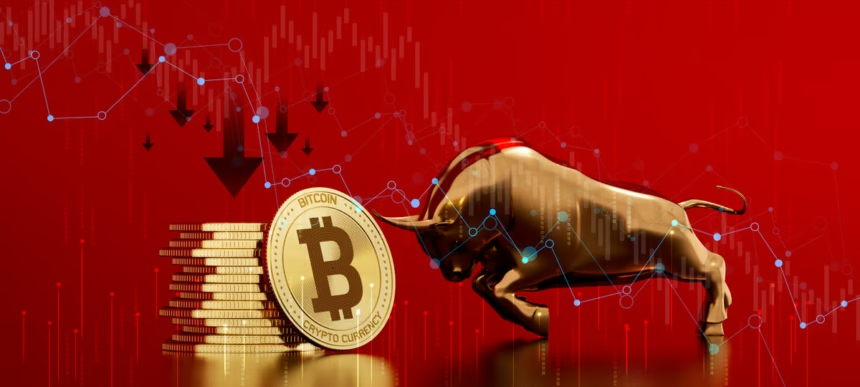
Critics are increasingly vocal as Bitcoin struggles to maintain its reputation as a safe haven against macroeconomic and geopolitical turbulence. Currently trading 44% below its peak from last October, Bitcoin’s market dynamics are drawing attention and scrutiny.
Over the past decade, Bitcoin’s astonishing rise of nearly 18,000% has led to a substantial market cap of approximately $1.4 trillion. However, this performance is not without its challenges, as Bitcoin competes for investment capital in a landscape crowded with enticing alternatives.
One of the most significant factors pulling capital away from Bitcoin is the burgeoning interest in artificial intelligence (AI). Companies at the forefront of AI development are investing heavily to enhance their computational capabilities, seeking to capitalize on what could be groundbreaking outcomes. This widespread enthusiasm is evident in the valuation of the so-called “Magnificent Seven,” a group of leading tech companies whose combined market cap recently reached $20 trillion, representing about one-third of the S&P 500.
In addition to AI, the U.S. housing market poses another considerable threat, with a value estimated at $55 trillion as of last June. As interest rates trend downward, there is potential for increased home values, which serve as a primary store of wealth for many American families. With the 30-year fixed mortgage rate exceeding 6% for the first time since 2022, the housing sector continues to attract significant capital.
Furthermore, U.S. Treasuries, with their nominal value of around $29 trillion, present yet another trillion-dollar challenge to Bitcoin. These securities are characterized by their liquidity and the security that comes with being backed by the U.S. government, making them an essential reserve asset for central banks globally.
Given Bitcoin’s liquid nature and its continuously fluctuating market price, it is inherently volatile. The sentiment among newer entrants to the Bitcoin market—be they individual investors, institutions, or even governments—may not be as steadfast as that of earlier adopters. This could potentially lead to quicker sell-offs during periods of market instability.
Despite these challenges, Bitcoin’s long-term value proposition remains unchanged. As the scarcest asset in the financial ecosystem, it still holds significant promise for future appreciation. As history has shown, the journey to realizing its full potential may test the patience of its supporters, but fundamentals indicate a brighter outlook for Bitcoin in the years to come.