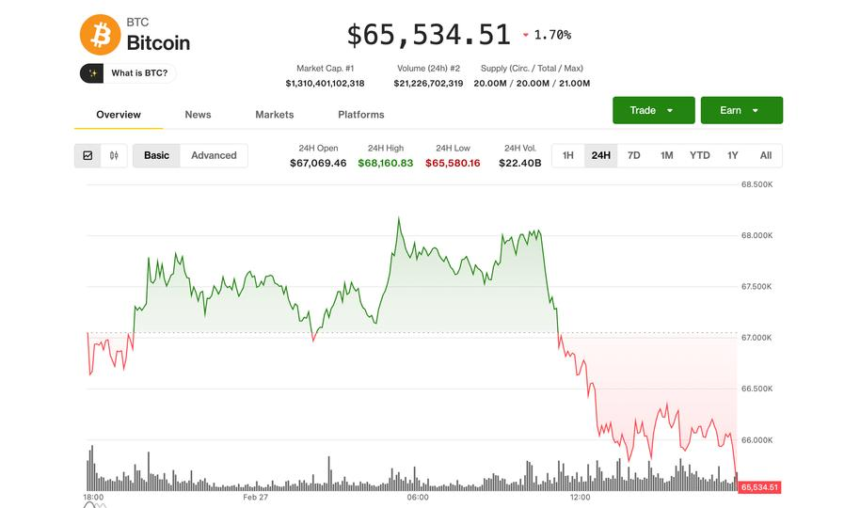
Bitcoin faced a notable decline, dropping below the $66,000 mark during the early hours of trading on Friday. The cryptocurrency, which had surged earlier in the week, fell sharply from its peak of around $68,000 to approximately $65,600, marking a 3% decrease. This downturn has erased much of the gains observed on Wednesday, reflecting a broader retreat in risk assets as macroeconomic uncertainties weigh heavily on investor sentiment.
The CoinDesk 20 Index, a broad-market measure of cryptocurrencies, mirrored this downward trend, declining by 2.3% over the past 24 hours. Key digital assets such as Ether (ETH), XRP, and Solana (SOL) experienced similar losses, with each also posting declines near 3%.
In the stock market, companies closely tied to cryptocurrency, such as MicroStrategy (MSTR), which is known for being the largest corporate holder of Bitcoin, saw their shares slip by 3%. Coinbase (COIN) also reported a decrease of over 2%. Meanwhile, Circle (CRCL), a stablecoin issuer, faced an almost 5% drop, interrupting a recent rebound that had previously boosted its stock by nearly 50% in just a few sessions.
Mining companies, whose fortunes have recently begun to tie into the development of artificial intelligence infrastructure, also fared poorly. Firms like Iris Energy (IREN), Cipher Mining (CIFR), Core Scientific (CORZ), and TeraWulf (WULF) lost between 6% and 8% as investors reacted to the shifting market dynamics.
This market activity coincided with declines in U.S. equity indices; the Nasdaq Composite fell by 0.8%, while the S&P 500 decreased by 0.6%. Investors are navigating a volatile landscape influenced by multiple macroeconomic concerns. Notably, the Producer Price Index (PPI) inflation reading for the previous month exceeded expectations, with core PPI rising 3.6% year over year—higher than the anticipated 3.0%. This prompted market analysts to increase bets on the likelihood of the Federal Reserve maintaining interest rates in its upcoming March meeting, with a 96% probability now assigned to no rate cuts.
Compounding these issues, anxiety over the stability of credit markets has emerged, marked by widening credit spreads. Private equity firms such as KKR, Ares, and Apollo Global Management saw their stocks plunge 6% to 7% to reach new lows amid these concerns.
International tensions have also added to the uncertainty, particularly with rising odds of U.S. military action against Iran as the U.S. commenced the evacuation of its embassy staff from Israel.
In the fixed-income market, the U.S. 10-year Treasury yield fell below 4% for the first time since November 2024. Concurrently, safe-haven assets such as precious metals gained traction, with gold prices rising by 1% to exceed $5,230 per ounce and silver surging by 4% to trade above $92. Crude oil prices also saw an increase, rising by 2.3% to cross the $67 per barrel mark.
Given the prevailing risk-averse atmosphere, analysts suggest that Bitcoin’s price may remain range-bound in the near future. Paul Howard, director at trading firm Wincent, indicated that following the February options expiry, traders appear to anticipate Bitcoin remaining below the $72,000-$74,000 range, with support around $54,000 likely through March. He cautioned that a conservative approach seems advisable, particularly as March has historically been a challenging month for major cryptocurrencies.