Bitcoin miners are rapidly shifting their focus from maintaining large bitcoin reserves to selling off their holdings as they venture into the burgeoning sector of artificial intelligence (AI) infrastructure. This transition marks a significant change from the traditional “HODLing” mentality that characterized many miners in the past.
The profitability of bitcoin mining has been under pressure due to increased competition, rising energy costs, and declining bitcoin prices. With peak profit margins during the 2021 bull market reaching as high as 90%, many miners who previously thrived on this model are now finding it challenging to remain viable. Current bitcoin prices are hovering around $66,000, a staggering 50% drop from the all-time highs seen in October.
In response to these challenges, numerous publicly listed miners are transitioning their operations to become “AI infrastructure” companies. Many of them have existing data centers that can readily accommodate AI computing machines, making the pivot somewhat seamless.
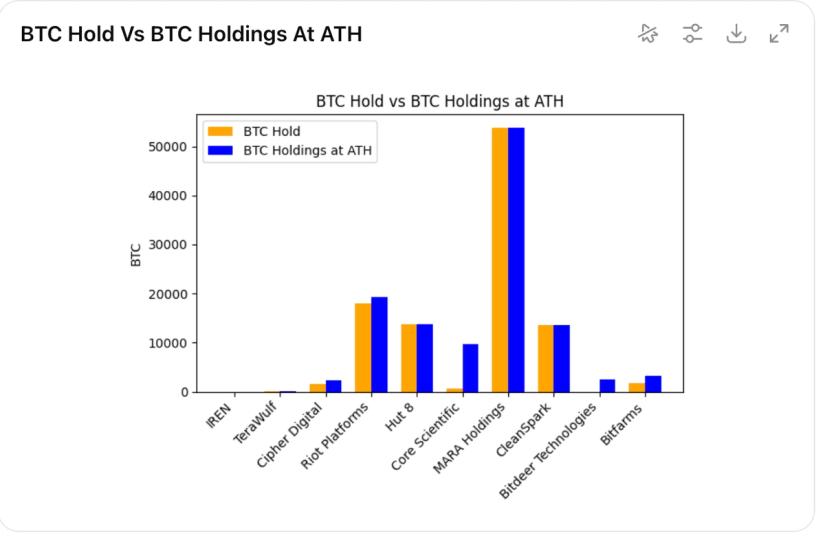
Among the miners taking this approach, IREN (IREN) has been vocal about its operational focus rather than ideological commitments to bitcoin. The company currently holds no bitcoin, emphasizing a strategy concentrated on infrastructure scalability.
TeraWulf (WULF) has also adopted a highly pragmatic approach. The company maintains a minimal bitcoin reserve of 15 BTC and prioritizes maintaining balance sheet flexibility to support AI-related growth initiatives.
Cipher Digital (CIFR), which rebranded from Cipher Mining, has made its intentions clear by announcing 2025 as a pivotal year for its shift toward high-performance computing (HPC) infrastructure. The company has already divested a 49% stake in its joint mining ventures for about $40 million worth of stock and now holds 1,500 BTC—down from a peak of 2,284 BTC.
Riot Platforms (RIOT) views bitcoin more as a funding instrument than a long-term asset, having liquidated nearly 1,100 BTC to finance acquisition efforts. Recently, Riot sold $200 million in bitcoin over the last two months of 2025, resulting in a current holding of 18,005 BTC compared to a previous high of 19,368 BTC.
Hut 8 (HUT) has expressed that bitcoin is no longer central to its long-term strategy. Instead, the company anticipates a decrease in its bitcoin exposure while focusing on its equity stake in American Bitcoin (ABTC), which holds 6,039 BTC. Hut 8 itself still retains 13,696 BTC.
Core Scientific (CORZ) is mirroring this trend as it accelerates its AI pivot, selling $175 million in bitcoin. Its current balance has dramatically decreased from 2,537 BTC at the end of 2025 to around 630 BTC, a far cry from its peak of 9,618 BTC.
MARA Holdings (MARA) has moderated its previous steadfast approach to “HODLing,” indicating a readiness to sell newly mined bitcoin opportunistically. While they hold 53,822 BTC—matching their all-time high—they have pledged roughly 28% of their holdings.
CleanSpark (CLSK) treats its over 13,000 BTC more as productive capital, engaging in activities like monetizing output, layering covered calls, and exploring bitcoin-backed credit lines for financing. Their current balance reflects a historical peak at 13,513 BTC.
In a significant move, Bitdeer Technologies (BTDR) has eliminated its bitcoin holdings entirely to finance the expansion of its AI data center operations, dropping from a peak of 2,470 BTC to zero.
Lastly, Bitfarms (BITF) has been straightforward about its strategy change, with CEO Ben Gagnon proclaiming, “We are no longer a Bitcoin company.” The miner holds 1,827 BTC, down from a peak of 3,301 BTC, emphasizing its commitment to AI infrastructure.
As the landscape shifts, the trend of bitcoin miners moving towards AI infrastructure is shaping the future of the industry, reflecting broader changes in investment priorities and market conditions.