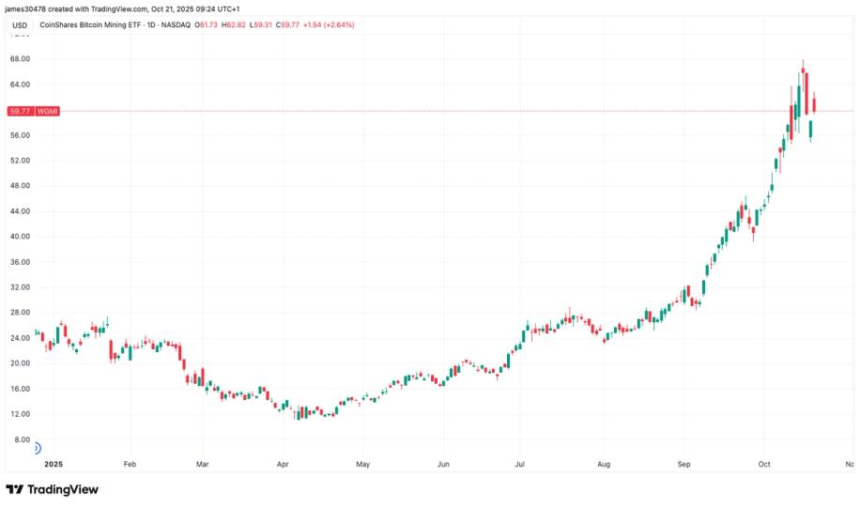
The recent surge in share prices within the artificial intelligence (AI) and high-performance computing (HPC) sectors has significantly impacted the landscape for bitcoin miners, leading to exceptional returns for those diversifying into these emerging industries. However, this explosive growth comes with associated risks. Bitcoin’s price has only risen by about 10% this year, and a downturn in corporate bitcoin treasuries has led to a notable shift in focus among miners, who are now seeking to transform their business models.
In response to the evolving market dynamics, bitcoin miners have become increasingly active in debt markets to finance extensive buildouts into AI and HPC sectors. A recent report from The MinerMag indicates that the combined issuance of debt and convertible notes from these miners reached record levels in the third quarter, with estimates nearing $6 billion. This burgeoning debt raises concerns about potential defaults, prompting investors to closely monitor the generation of meaningful revenues from these strategic pivots.
Prominent players in the space, such as TerraWulf, MARA Holdings, and Cipher, have collectively raised substantial amounts through convertible bonds during the quarter. Additionally, CleanSpark has tapped into credit lines to solidify its financial position. The momentum has continued into the fourth quarter, with TerraWulf launching a $3.2 billion private placement of senior secured notes, which marks the largest single offering ever made by a public miner. Following this, IREN issued a $1 billion convertible bond, and Bitfarms announced a $300 million convertible note.
The structures of these financial instruments vary. Some, like IREN’s offering, feature a zero-coupon structure, while others, such as TerraWulf’s issuance, come with higher costs. The latter boasts a 7.75% coupon, leading to an annual interest expense of approximately $250 million, starkly surpassing the company’s revenue projections of $140 million for 2024.
This current fundraising cycle stands in contrast to the bear market of 2022, when the collapse of hashprice led to significant setbacks and asset seizures by lenders. Notably, Core Scientific’s Chapter 11 bankruptcy highlighted the vulnerabilities in the sector. The MinerMag suggests that focusing on AI and HPC may help mitigate some risks associated with high levels of debt by diversifying revenue streams.
The market has shown a propensity to reward miners who transition from solely bitcoin operations to ventures in AI and HPC. While issuing convertible bonds can lead to shareholder dilution, the shift is garnering interest from a new pool of investors. The CoinShares Bitcoin Mining ETF, which serves as a benchmark for the broader bitcoin mining sector, has appreciated by 160% year-to-date, reflecting the optimism surrounding this strategic pivot within the industry.