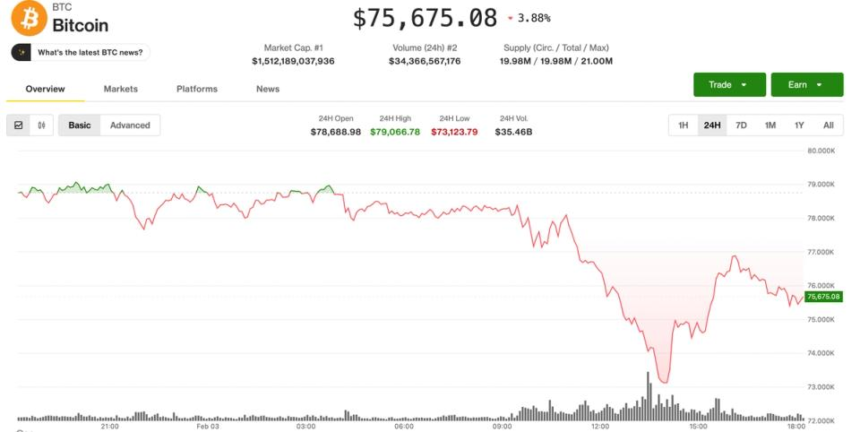
Bitcoin experienced significant volatility on Tuesday, hitting a 14-month low before recovering slightly. The largest cryptocurrency dipped to $72,900 during the early U.S. session, marking its weakest level since November 2024, coinciding with Donald Trump’s election victory. However, it staged a rebound of approximately 5%, climbing back to around $76,800, although this increase proved short-lived.
Ethereum also saw notable movement, with its ether token rising about 10% from session lows before retracing some of its gains, trading above $2,300 according to CoinDesk data.
This market turbulence followed news that Congress had reached an agreement to end the recent partial government shutdown, which provided some immediate relief to investor sentiment. In addition to the political developments, Nvidia CEO Jensen Huang made an appearance on CNBC, addressing concerns about the company’s relationship with OpenAI amidst rumors of friction. Huang dismissed these speculations as “complete nonsense,” reiterating Nvidia’s commitment to investing in OpenAI’s next fundraising round. His reassurances came amid rising concerns over the stability of OpenAI, a significant player in the ongoing AI-driven tech rally.
Despite the bounce-back, the sharp drop in cryptocurrencies took a toll, with total liquidations across digital asset derivatives amounting to $740 million in the last 24 hours, as reported by CoinGlass. Long positions, which bet on higher prices, were hit particularly hard, with liquidations totaling $287 million in Bitcoin longs and $267 million in Ethereum longs.
From a technical standpoint, Bitcoin’s drop below the April 2025 “tariff tantrum” lows has triggered a significant breakdown, raising fears of a deeper market correction. Nevertheless, market analyst Benjamin Cowen, the founder of Into The Cryptoverse, noted that pervasive bearish sentiment could pave the way for a potential short-term relief rally. He highlighted a historical pattern where Bitcoin’s dips below prior lows often precede such rallies.
Cowen further cautioned that failure to mount a rally soon could lead to challenging conditions for Bitcoin in the coming midterm year, drawing parallels to previous bear markets in 2018 and 2022 that coincided with U.S. midterm elections. “The bear narrative has been really strong for a while, and I would expect a countertrend rally soon to give the bulls some hope,” he remarked in a recent post on social media platform X.