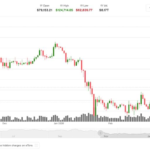
At 9 a.m. Eastern Time today, Bitcoin is priced at $68,269.62, marking a significant decrease of $1,086.17 from the previous day. This current value also represents a drop of approximately $10,840 compared to the price one year ago.
In detail, Bitcoin’s price history reveals a complex narrative of volatility and potential. Yesterday, Bitcoin was valued at $69,355.79, reflecting a 1.56% decrease. Looking back a month, the digital asset’s price was slightly higher at $68,208.41, seeing a minimal increase of 0.08%. However, the longer-term picture shows a more troubling trend, with the price one year ago recorded at $79,109.77, a drop of 13.70% over that period.
Initially launched in 2009, Bitcoin is recognized as the first cryptocurrency and remains the most notable digital coin, boasting a market capitalization of approximately $1.33 trillion. This puts it well ahead of Ethereum, the second-largest cryptocurrency, which holds around $233 billion in market value.
Bitcoin operates on a decentralized network, allowing for peer-to-peer transactions without any intermediary, such as banks or government authorities. Its appeal lies in its potential as a hedge against inflation and as a novel asset class for investors. Over the last decade, Bitcoin has seen extraordinary growth, offering returns substantially higher than those of many traditional stock market indices. This performance has drawn considerable attention, but its price is also characterized by extreme volatility, resulting in sharp fluctuations.
The journey of Bitcoin has not been straightforward. Its historical price trajectory includes monumental rises and sharp declines. A notable anecdote from its early history involves software developer Laszlo Hanyecz, who famously spent 10,000 Bitcoins on two pizzas—an amount that would be worth over $668 million today.
Several factors influence Bitcoin’s price dynamics. Speculation by investors plays a significant role, with market sentiment driving demand, often more than the underlying fundamentals. Additionally, corporate adoption influences its value; for example, Bitcoin’s acceptance by companies like Tesla and Ferrari has had a positive impact on its price.
Broader economic conditions also affect Bitcoin. While it does not respond to inflation data or Federal Reserve policies like traditional assets, it tends to perform better in a robust economy where consumers are more willing to explore alternative investments. Regulatory changes in the cryptocurrency space can also create uncertainty, further impacting Bitcoin’s market value.
For potential investors interested in Bitcoin, there are various avenues available:
-
Buying Bitcoin on an Exchange: The most direct method involves creating an account on a cryptocurrency exchange and purchasing Bitcoin linked to a bank account.
-
Investing in Bitcoin ETFs: For those who prefer not to hold Bitcoin directly, exchange-traded funds (ETFs) provide a way to invest without the complexities of managing a digital wallet.
-
Investing in Crypto Stocks: Stocks in companies that are involved in the crypto space, such as tech firms or payment processors, can serve as indirect exposure to Bitcoin.
-
Bitcoin IRAs: Investors looking to save for retirement may find Bitcoin IRAs appealing, enabling them to use retirement funds for cryptocurrency investments while enjoying tax benefits.
Furthermore, Bitcoin is not the only cryptocurrency available. Ethereum, priced at $2,079.89, offers a decentralized computing platform for developers, while Tether remains relatively stable, pegged to the dollar, and XRP focuses on efficient cross-border transactions.
As for its future, opinions on Bitcoin’s trajectory are mixed but generally optimistic. Predictions for its value by 2030 vary widely, with some models suggesting prices could exceed $700,000, while more conservative estimates hover around $300,000. Bitcoin’s all-time high price to date is recorded at $126,198.07, achieved on October 6, 2025.
Investors can purchase fractions of Bitcoin thanks to the availability of fractional investing options on many exchanges. As a beginner looking to enter the market, the process typically involves opening an account with an exchange and transferring funds for direct purchase of Bitcoin.
Bitcoin serves multiple functions: from being a digital currency for transactions to a speculative investment option. Despite its historical outperformance relative to traditional stocks, its volatility makes it prudent for investors to approach with caution. Analysts suggest that a well-diversified portfolio can mitigate risks linked to Bitcoin’s price swings, recommending it as a long-term holding for those prepared to weather market fluctuations.