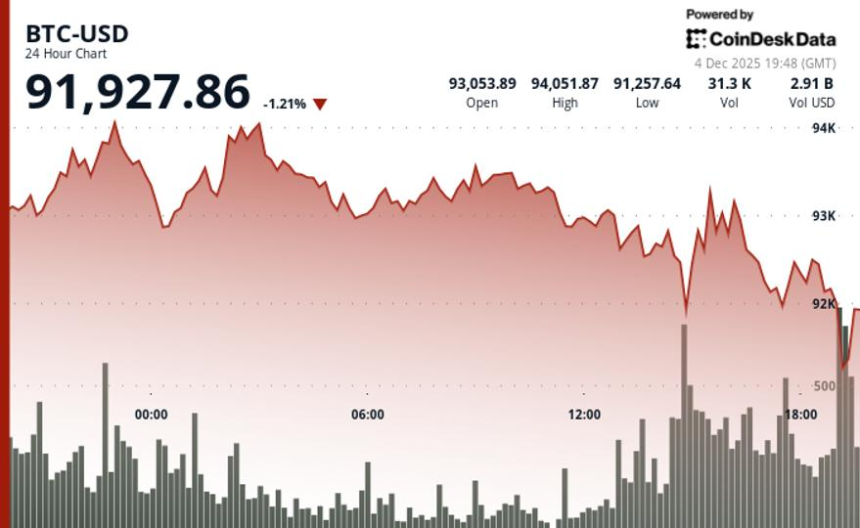
Bitcoin experienced a notable retreat on Thursday, sliding back to $92,253.22 after briefly reaching $94,000 during the overnight trading hours. This decline continued the choppy, rangebound action that has characterized the cryptocurrency market recently, reflecting a volatile week marked by significant price fluctuations.
Ethereum’s ether showed relative stability, dropping only 0.7% to approximately $3,139.42, managing to stay above the $3,100 mark during the afternoon session. However, other altcoins faced tougher challenges, with notable declines in XRP, Hedera (HBAR), Bitcoin Cash (BCH) at $590.97, and privacy-focused Zcash (ZEC) which all slipped by 4% to 5%. Overall, the broad-market CoinDesk 20 Index noted a 2% decrease.
Despite the recent pullback, Bitcoin has maintained a secure level above the support threshold established earlier in the week around $85,000. This suggests a possible stabilization in the market, particularly as liquidity tends to diminish during the end-of-year period. Paul Howard, senior director at trading firm Wincent, indicated in a recent analysis that the market may be settling into a holding pattern. He highlighted the ongoing correlation between cryptocurrency prices and global macroeconomic developments, noting that December often sees diminished liquidity yet the past week has established a higher price floor.
Howard anticipates that Bitcoin will likely remain in a trading range between $85,000 and $95,000 for the remainder of the month, barring any significant macroeconomic news. He also pointed out potential opportunities for altcoins, which historically perform well in lower liquidity and higher volatility environments.
Looking at the broader macroeconomic landscape, traders are keenly focused on the upcoming decisions from the U.S. Federal Reserve and particularly the Bank of Japan (BoJ). Mark Connors, founder and chief macro strategist at Risk Dimensions, emphasized that the BoJ’s rate decision could be pivotal for the future of the yen-funded carry trade. This strategy allows investors to borrow in yen to invest in higher-yielding assets. Connors speculated that if the BoJ decides to keep interest rates steady, it could bolster demand for riskier assets, including Bitcoin, alongside equities and gold.