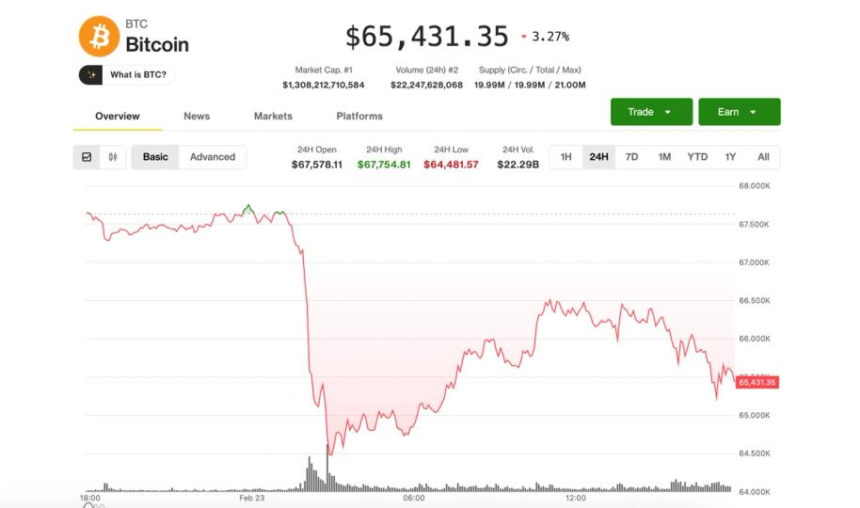
Bitcoin’s brief recovery from a significant overnight downturn was short-lived during U.S. morning trading on Monday, as broader risk markets experienced a notable decline. Priced at $65,400 around noon on the East Coast, Bitcoin had dropped 35% over the previous 24 hours.
This drop coincided with a downturn in U.S. equities, with both the S&P 500 and the tech-heavy Nasdaq 100 falling more than 1%. A notable factor in this decline was the renewed weakness in software stocks and private equity firms. The iShares Expanded Tech-Software ETF (IGV) saw a steep decline of 5%, hitting a fresh 52-week low and now stands nearly 35% lower since October. Concerns surrounding generative AI disrupting conventional software business models have heavily influenced market sentiment, leading to speculation that cryptocurrencies like Bitcoin, viewed as mere software, are similarly vulnerable. Recently, price movements of Bitcoin and IGV have shown a near-perfect correlation.
The prevailing bearish outlook has also been fueled by worries that advancements in AI might be steering markets toward a significant negative credit event, reminiscent of the global financial crisis in 2008. This anxiety is evident in the plunge of private equity shares, many of which are deeply interconnected with the software sector. Firms like Owl Capital have faced turmoil, with a 3.5% drop on Monday and a staggering 32% decline year-to-date. Other major players such as Blackstone, Ares Management, and Apollo Global Management also recorded losses between 6% and 8%.
Often viewed as a high-beta proxy for technology and general liquidity conditions, Bitcoin’s decline on Monday reflected these trends. Despite holding above its early February lows, Bitcoin’s struggle to break free from a tight price range of $60,000 to $70,000 underscores the fragility of current risk appetite.
Further complicating matters, uncertainty surrounding global tariffs has emerged following a Supreme Court ruling that restricted President Trump’s broad use of tariffs. Market strategist Joel Kruger from LMAX Group highlighted that this uncertainty has contributed to a classic risk-off environment, prompting investors to retreat from speculative assets such as cryptocurrencies. Kruger noted that Bitcoin is increasingly behaving more like a high-beta risk asset rather than the “digital gold” it has often been dubbed.