As 2025 approaches its conclusion, the bitcoin market has encountered significant challenges, evidenced by a year-to-date decline of approximately 7%, with bitcoin currently valued at $88,777.23. In stark contrast, gold, the S&P 500, and technology stocks have all reached unprecedented highs, reshaping the landscape for public bitcoin mining companies.
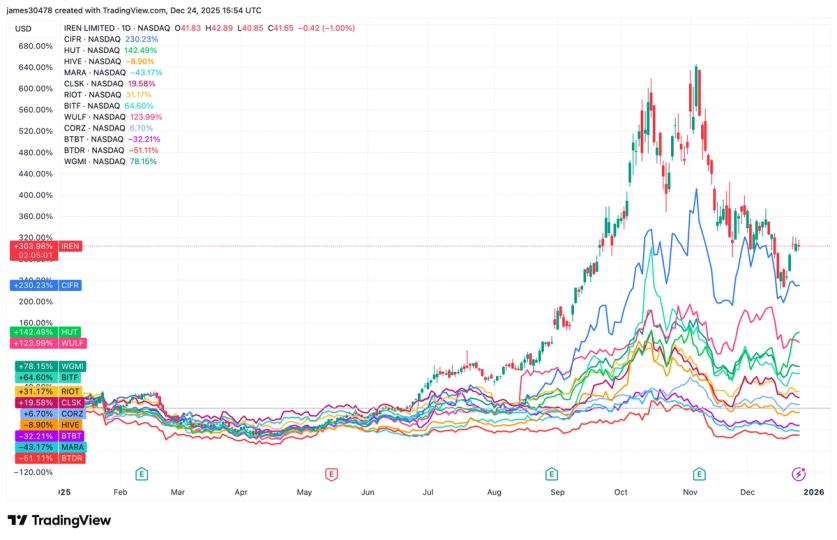
Divergence in performance among these companies reveals a distinct trend—those investing in artificial intelligence (AI) and high-performance computing (HPC) infrastructure have experienced remarkable gains. IREN (IREN) has emerged as a leader in this space, boasting a staggering year-to-date uptick of 300%. This substantial growth can largely be attributed to lucrative GPU cloud contracts and support from major player Microsoft.
Following IREN, Cipher Mining (CIFR) has reported an impressive gain of 230% as the company strengthens AI hosting collaborations, particularly with Fluidstack. Hut 8 (HUT) also recorded a notable increase of approximately 139%, bolstered by its recent announcement of a $7 billion, 15-year lease for an AI data center that will operate at 245 megawatts at its River Bend site in Louisiana.
On the flip side, three of the four largest bitcoin holders among publicly traded miners have struggled to keep pace with their AI-focused counterparts. Marathon Digital (MARA), which holds the highest amount of bitcoin among miners at 53,250 BTC, has fallen sharply by 44% year-to-date. CleanSpark (CLSK) and Riot Platforms (RIOT), holding 13,011 BTC and 19,324 BTC respectively, realized modest gains of 16% and 32% after delaying their AI diversification efforts until late in the year.
Core Scientific (CORZ) opted to remain independent, rejecting a $9 billion all-stock acquisition proposal from CoreWeave in October. The company is betting on its potential to generate higher value on its own amid increasing AI demands, resulting in a year-to-date share price increase of just 9%. Meanwhile, Bitdeer Technologies (BTDR) has struggled significantly, with a staggering 50% decline in value. This downturn was exacerbated by an unsatisfactory earnings report for Q3, which revealed a larger-than-expected net loss and raised concerns about delays in its ASIC chip development—casting doubt on its AI expansion strategies.
The trends observed this year highlight a pivot within the industry, as mining companies reimagine their sites for AI data centers. This strategic shift has proven to be more lucrative than traditional bitcoin-only operations, signaling a transformative moment in the mining sector.