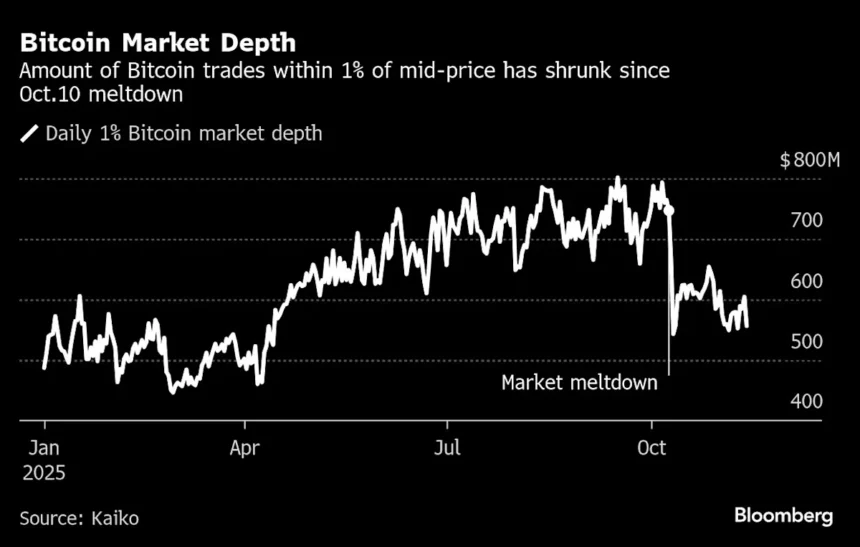
The cryptocurrency market is grappling with significant challenges, particularly with Bitcoin, which has seen a nearly 30% decline from its peak earlier in the year. Instead of skyrocketing as many had anticipated, Bitcoin is struggling to keep pace with more traditional investments like U.S. Treasury bonds and technology stocks. Once heralded as a high-growth asset, an inflation hedge, and a diversifier for investment portfolios, Bitcoin now risks closing the year in negative territory, unable to deliver on these expectations.
In a notable turn of events, gold—often dismissed by Bitcoin advocates as an antiquated asset—has been outperforming Bitcoin, which had been dubbed “digital gold.” This year, in a backdrop of declining interest rates and a cautious risk appetite among investors, traditional assets such as long-term bonds and the Nasdaq index have also managed to surpass Bitcoin’s performance.
On a particularly concerning note for investors, Bitcoin briefly dipped below the $90,000 mark—the average entry price for those who invested through exchange-traded funds (ETFs) since their inception. This drop left many typical ETF investors at a loss temporarily. Following this decline, Bitcoin recovered slightly, trading around $93,241, a 1.5% rise from its recent seven-month low.
Investor sentiment was amplified earlier in the year when expectations were high for cryptocurrencies, bolstered by a supportive White House stance and new regulations paving the way for ETF launches tied to various tokens. Institutional investors also appeared to be embracing digital assets. However, for those who entered the market near its peak, the narrative is turning into a familiar tale of enthusiasm followed by a sharp downturn and growing skepticism about Bitcoin’s future.
Despite being marketed as a reliable inflation hedge and a stable store of value, Bitcoin’s volatility remains persistent, and its reliability is increasingly questioned. The cryptocurrency has struggled to provide a protective buffer against losses incurred from external market pressures or to capitalize on market rebounds. This elusiveness in fulfilling its intended role is a source of frustration for fund managers and professional investors who had envisioned cryptocurrency as a strategic diversification tool.
Various theories have surfaced suggesting why Bitcoin has underperformed. Some analysts attribute the current scenario to a sharp market selloff earlier in October, which wiped out approximately $19 billion in leveraged positions and may have left lingering damage on investor sentiment. George Mandres, a senior trader at XBTO Trading, emphasized the lasting scars and weakened appetites among market players, indicating that the October crash has had deeper implications than initially assumed.
Looking beyond Bitcoin, broader market weaknesses are also a factor. Recent economic data from Asia, particularly soft growth statistics from China, coupled with a reconsideration of global tech valuations, particularly ahead of crucial earnings reports, have contributed to the broader market malaise. Timothy Misir, head of research at digital asset analytics firm BRN, noted that in this uncertain environment, cryptocurrencies have become a leveraged reflection of macroeconomic tightening rather than a safe haven.
Amid speculation about an impending bear market, many traders are now adopting a defensive posture. Demand for options that provide protection against price drops around the $85,000 and $80,000 thresholds has surged, with market data suggesting only a minimal chance—less than 5%—of Bitcoin reaching its previous record high of over $126,000 by the end of the year.
Despite the gloomy outlook, Brendan Fagan, an FX strategist for Markets Live, posited that Bitcoin might be attempting to regain its position as a leader in the market, indicating a potential stabilization if it can maintain above the $90,000 threshold. If successful, this could mark a critical turning point for the digital asset landscape, possibly restoring some confidence among investors.