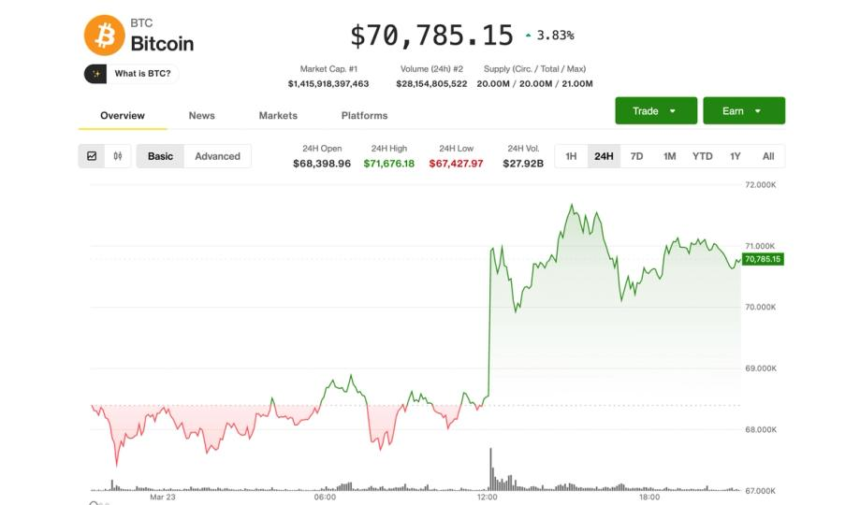
Bitcoin maintained its strength on Monday, trading at $70,595.02 after a notable early rise above the $70,000 mark. The cryptocurrency’s recent surge appears to be influenced by ongoing geopolitical conversations, particularly between the U.S. and Iran. President Donald Trump announced a five-day halt on strikes against Iranian energy sources, attributing this pause to what he described as “productive” diplomatic engagements. Despite Iranian officials refuting the existence of such talks, the market reaction was generally positive, with risk assets displaying stability.
As the day progressed, Bitcoin hovered just below $71,000, marking a 3.8% increase over the last 24 hours. Notably, altcoins also saw impressive gains, with ether (ETH), solana (SOL), and dogecoin (DOGE) each rising by approximately 5%. Additionally, crypto-related stocks experienced a boost, particularly bitcoin mining companies, which have begun to show correlations with AI infrastructure shares. Noteworthy performers included Hut 8, which surged over 11%, while Bitfarms, Cipher Mining, CleanSpark, Riot Platforms, and TeraWulf all saw advances between 6% and 7%.
Traditional financial markets mirrored this uptrend, as both the S&P 500 and Nasdaq closed around 1.2% higher. The temporary pause in military actions seems to have alleviated some strain in energy markets, although traders are advised to remain cautious regarding the potential rebound in risk assets.
Jasper de Maere, an OTC trader at Wintermute, commented on the shifting macroeconomic landscape, noting that the extent of future gains will depend heavily on developments in the upcoming days. He suggested that if oil prices stabilize and shipping in the Strait of Hormuz returns to normal, inflation concerns may diminish. This scenario could lead to renewed expectations for interest rate cuts, which would alleviate some obstacles for cryptocurrencies. Under such conditions, bitcoin could aim for a range between $74,000 and $76,000—a level that has previously restricted rallies.
Conversely, should there be a breakdown in diplomatic discussions or renewed disruptions in energy supplies, de Maere warned that oil prices could surge again. This would heighten inflation fears, potentially pushing markets into a risk-averse posture and driving bitcoin down towards the mid-$60,000s.