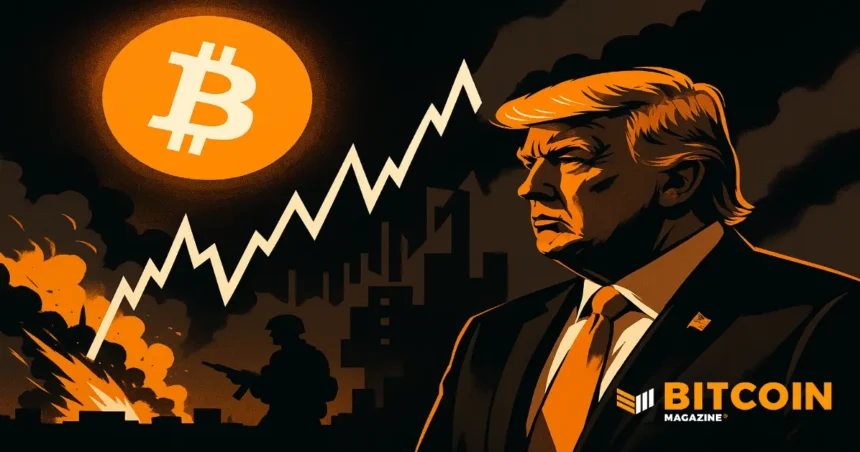
Bitcoin experienced a notable rise at the start of the week, climbing past $71,000 before experiencing a slight pullback. This uptick is attributed to heightened market sensitivity to geopolitical tensions, particularly involving the U.S. and Iran. Over the weekend, Bitcoin had been trading below $68,000, leaving investors anxious as various reports regarding peace negotiations in the Middle East circulated.
The significant price movement occurred shortly after U.S. President Donald Trump announced a five-day delay on planned strikes against Iranian power plants. He characterized the discussions with Tehran as “very good and productive,” indicating hope for a “complete and total resolution” of the ongoing hostilities. In a swift reaction, Bitcoin surged to an intraday peak of $71,811, according to Bitcoin Magazine Pro, before retracting to about $70,000.
This rally resulted in the liquidation of roughly $791 million in leveraged crypto positions, including $425 million in long positions. However, the enthusiasm was dampened shortly after, as Iran’s Foreign Ministry, through state media, refuted Trump’s portrayal of the talks, stating, “We are not the party that started this war, and all these requests should be referred to Washington.” This denial fostered continued uncertainty in the market, resulting in heightened volatility during early-week trading.
Despite the fluctuations, Bitcoin has shown a certain degree of resilience over more extended periods. Since February 28, when U.S.-Israeli airstrikes spurred Iranian retaliatory actions and the blocking of the Strait of Hormuz, Bitcoin has appreciated by approximately 7%. This performance stands in stark contrast to traditional markets, including the S&P 500, which has seen a decline of 4.6%, and gold, which has fallen by 17%, trading currently near $4,428.
Analysts suggest that Bitcoin’s outperformance can be linked to ongoing market deleveraging trends that began after its peak of $126,080 in October 2025. The volatility of the past week also correlates with broader economic factors, such as the rise in U.S. 10-year Treasury yields, which climbed to 4.36% on Monday amidst inflation concerns intensified by soaring oil prices. Brent crude, which had surged to over $107 per barrel following the closure of the Strait of Hormuz, experienced an 8% decrease on Monday, further illustrating the interconnectedness between oil markets, inflation expectations, and risk assets like Bitcoin.
On a technical analysis front, Bitcoin remains in a symmetrical triangle formation on its daily chart, indicating a phase of consolidation. A sustained close above $75,000 this week could potentially set the stage for gains reaching $85,000 to $90,000. Conversely, a decline below $67,000 could signal a return to recent low points. As of the latest data, Bitcoin is trading near $71,000.