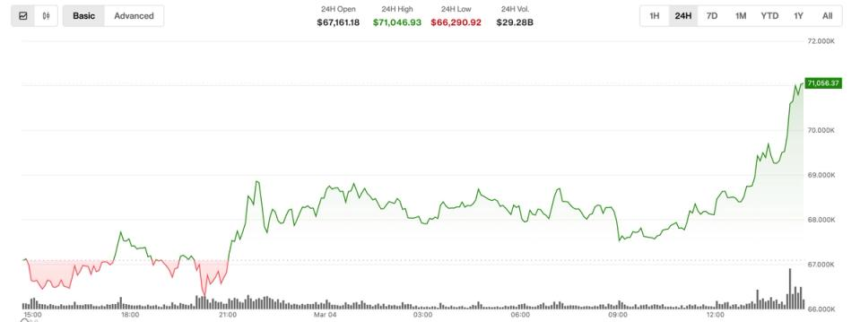
Bitcoin has demonstrated remarkable resilience amid escalating turmoil in the Middle East, with its value climbing to $71,023 during European trading hours Wednesday. This surge represents over a 6% increase within a 24-hour period, reflecting a trend that has seen other major cryptocurrencies follow suit. Ether (ETH), XRP (XRP), and Solana (SOL) experienced gains of approximately 4% to 6%, respectively, while the broader CoinDesk 20 Index rose more than 5% to reach 2,025 points.
In a daily newsletter, Tagus Capital noted that Bitcoin appears to be developing defensive characteristics during crises, suggesting a shift in its perception as a high-beta asset. This sentiment indicated a growing disparity between Bitcoin’s resilience and gold’s recent underperformance, highlighting that even traditional safe-havens are not entirely immune to broad market dynamics. As gold prices fell from a peak above $5,400 per ounce earlier in the week to $5,160, analysts pointed to Bitcoin’s flexibility as a contributing factor to its ongoing appeal.
The ongoing conflict involving Israel, the U.S., and Iran has intensified, particularly with Iran’s recent actions to obstruct oil supplies through the Strait of Hormuz, which could lead to global energy price inflation. Despite these geopolitical developments, Bitcoin’s price has remained relatively stable, with downside support holding firm around $65,000. In contrast, Asian equity markets, notably South Korea’s Kospi index, have been adversely affected by rising oil import costs, reflecting the broader economic uncertainty.
Market participants are increasingly viewing Bitcoin as an alternative asset during times of global distress, underscoring a potential shift in investment strategies as political tensions continue to mount. The contrasting performance of Bitcoin and gold amid crisis signals evolving perceptions in the investment landscape, raising questions about the long-term implications for both assets in similar future scenarios.