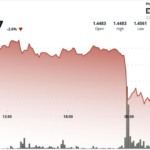
Bitcoin experienced a significant decline on Thursday, falling to $70,000, as on-chain metrics and market flows indicated a structurally weaker environment. In conjunction with this, global equities appeared to struggle for direction, amplifying the challenges faced by the cryptocurrency market. According to CryptoQuant’s latest weekly report, the current downturn comes across as a signal of deeper market weakness rather than a standard correction. The firm’s Bull Score Index has plummeted to zero, with Bitcoin trading far below its peak in October, suggesting a diminishing buyer base and tightening liquidity rather than merely a digestion of prior gains.
Supporting this analysis, data from Glassnode pointed to weak spot trading volumes and an increasing demand vacuum. The market’s decline seems to stem less from panic selling and more from a noticeable drop in overall market participation. At the time of reporting, Bitcoin was valued at $70,766, reflecting a drop of 7.38% within the preceding 24 hours.
A sharp shift in institutional flows has become evident compared to last year. US spot Bitcoin exchange-traded funds, which were net buyers in the same timeframe last year, have now transitioned into net sellers, creating a significant year-on-year demand gap amounting to tens of thousands of bitcoins. Additionally, indicators related to US investor behavior are mirroring a decrease in demand. Historically, robust US spot demand has been synonymous with prolonged bull-market cycles; however, that correlation is currently absent.
Liquidity trends continue to signal bearish conditions. The expansion of stablecoins, typically indicative of increased trading activity and risk-taking, has come to a halt. Data from CryptoQuant revealed that the growth of the market capitalization for USDT has gone negative for the first time since the beginning of 2023. Furthermore, indicators of longer-term apparent demand growth have also experienced a sharp decline from last year’s highs, reinforcing concerns about diminishing market participation.
From a technical viewpoint, Bitcoin is trading below its 365-day moving average, with on-chain valuation models establishing significant support within the range of $70,000 to $60,000. Amidst this backdrop, the broader macroeconomic environment and policy uncertainties are complicating recovery prospects. Bitcoin’s price trajectory is increasingly mirroring that of high-beta technology stocks, drifting away from its traditional role as a safe-haven asset. Market predictions show that traders largely expect no changes in Federal Reserve policies during the upcoming April meeting, with only modest expectations set for a potential rate cut in June, limiting near-term liquidity relief.
Political developments have further contributed to the market’s uncertainty. President Donald Trump’s remarks regarding his Federal Reserve nominee, Kevin Warsh, hinted that a Fed chair advocating for higher rates “would not have gotten the job,” which has dampened previous hopes surrounding central bank independence.
The volatility within the market persists, as indicated by Bitcoin’s frequent price movements during US trading hours. Falling below prior support levels has sent Bitcoin into territory not observed since late 2024, although brief rebounds were noted. Macro assets have also struggled to maintain momentum, with gold unable to sustain its support above $5,000 and US equities opening on a negative note. Trading firm QCP Capital emphasized ongoing macro uncertainty, stating, “Crypto remains volatile.” They noted the fading shutdown overhang in macro environments while cautioning about the speed at which fiscal standoffs could resurface.
Additionally, trader CJ suggested that Bitcoin could face further declines of approximately $10,000, although short-term relief rallies may also be on the horizon. Analysts highlighted the significance of Bitcoin’s 200-week exponential moving average, currently near $68,000, as a potential safety net amidst rising market volatility, which has seen total 24-hour crypto liquidations surpassing $800 million.