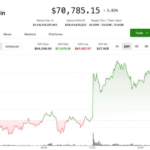
Bitcoin remains steady below the $90,000 mark, but Arthur Hayes, co-founder of BitMEX, suggests that this period of consolidation may be hiding a significant liquidity-driven market movement that could propel the cryptocurrency to an impressive $200,000 by 2026.
In his latest essay titled “Love Language,” Hayes discusses the Federal Reserve’s newly introduced “Reserve Management Purchases” (RMP) program, which he posits is merely a repackaged version of Quantitative Easing (QE). He argues that the shift in terminology is designed to temper market reactions and avoid alarming investors by avoiding explicit references to money printing.
Hayes contends that while the Federal Reserve frames RMP as a technical operation involving short-term Treasury bills, the economic consequences are similar to those of traditional QE. The central bank engages in the creation of new money to buy Treasury bills from money market funds, which subsequently reinvest that capital back into Treasury issuances or the repo market. This mechanism, he argues, continues to fuel government funding and enhances liquidity within the financial system.
Challenging discussions surrounding whether the RMP is distinctly different from QE, Hayes emphasizes that the critical takeaway is the expansion of the balance sheet. In such an environment, he positions Bitcoin and gold as robust hedges against the ongoing debasement of currency.
Hayes also notes that the anticipated cyclical patterns for Bitcoin have shifted. The former four-year cycle appears to have evolved into a “permanent” cycle of debt monetization. He expresses caution, predicting that a rapid rally in Bitcoin’s price is not immediately forthcoming. Current market conditions lead to perceptions that RMP is less stimulative compared to traditional QE.
As he looks ahead to early 2026, Hayes suggests that Bitcoin might stabilize between $80,000 and $100,000 as investors evaluate the implications of the Fed’s policy shift. However, he anticipates that as RMP becomes better understood as a form of ongoing money creation—and as central banks worldwide adjust their strategies to safeguard their currencies—there could be a substantial liquidity influx into risk assets.
With this in mind, Hayes forecasts that Bitcoin’s price could recover to $124,000 before potentially soaring to the much-coveted $200,000 range by 2026. This prediction highlights a significant opportunity for investors navigating the evolving financial landscape shaped by central bank policies.