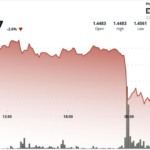
Bitcoin’s recent decline has raised alarms about the potential repercussions for the broader stock market. On Monday, the world’s leading cryptocurrency traded at $91,529, reflecting a drop of approximately 2.9% for the day. This decline follows a brief recovery after Bitcoin reached a six-month low on Friday. Coinciding with Bitcoin’s downturn, the S&P 500 index also registered a 1.3% decrease.
eToro analyst Bret Kenwell highlighted that Bitcoin’s price movements often serve as a “leading indicator” for trends in the U.S. stock market. He cautioned that a continued decrease in Bitcoin’s value could potentially lead to further losses in U.S. equities. Kenwell noted that if Bitcoin holds below the significant $90,000 threshold, it could trigger heightened selling pressure and bearish momentum, ultimately impacting various risk assets, including U.S. stocks.
Over the past week, Bitcoin’s value has dropped 13%, while the S&P 500 has seen a decline of 2.8%. This correlation is particularly relevant as a substantial share of investors in artificial intelligence stocks—integral to the S&P 500—also hold Bitcoin, linking the two markets more closely. Analysts are closely monitoring Bitcoin as a potential barometer for whether the stock market will maintain its downward trajectory.
Adding to the concerns, Greg Magadini, director of derivatives at the crypto analytics firm Amberdata, suggested that Bitcoin might face sharper declines ahead, particularly amid challenging credit market conditions and a prevailing negative sentiment among investors. He mentioned the risks for significant holders of Bitcoin, such as Strategy, noting that if the markets turn bearish collectively, it could lead to a scenario where digital asset holders are forced to liquidate their positions.
Further complicating the situation, there are indications that the Federal Reserve may refrain from cutting its overnight benchmark rate at its December meeting. Current trading data indicates a 55% likelihood of the Fed maintaining its existing rates, which could diminish the borrowing climate and lead to additional losses for both digital assets and equities.
Conversely, some analysts on Wall Street are fostering a more optimistic outlook for Bitcoin, pointing to several structural trends that support its long-term viability. Bernstein analyst Gautam Chhugani underscored the significance of institutional ownership and the prospects of a potential U.S. crypto market structure bill passing next year. Chhugani characterized the recent price fluctuations as a minor and short-term correction, asserting that the secondary market selling appears to have been adequately absorbed.
eToro’s Kenwell echoed this sentiment, asserting that Bitcoin’s fundamentals remain robust enough to safeguard against substantial price declines. He views the current market behavior as indicative of consolidation rather than a fundamental structural shift.
As the situation evolves, investors remain on edge, analyzing Bitcoin’s trajectory for clues about broader market movements and potential investment strategies. The interplay between cryptocurrency and traditional equity markets continues to warrant close scrutiny in these uncertain times.