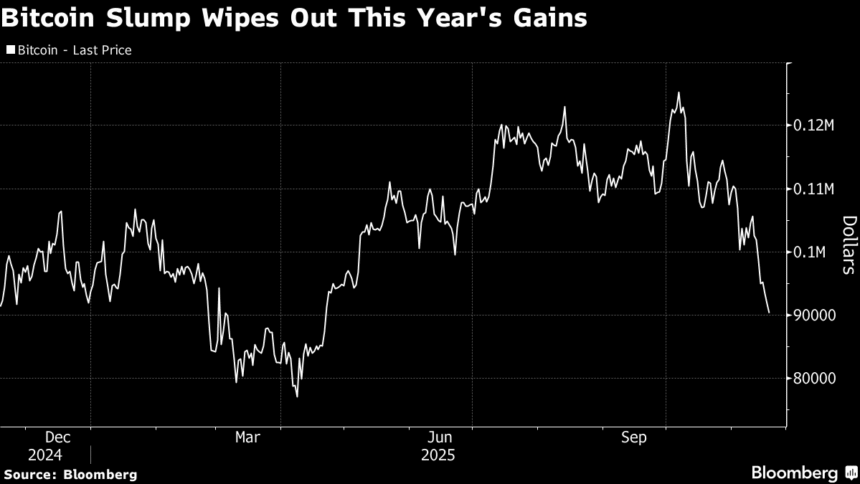
Bitcoin’s recent drop below $90,000 has intensified concerns across Asia’s financial markets, exacerbating an already significant downturn on Tuesday. The cryptocurrency, which saw a decline of as much as 2.8%, has now erased all its gains for the year, sparking fears that leveraged investors may trigger a damaging cycle of selling.
As Bitcoin’s value plummeted, the MSCI Asia Pacific Index experienced a steep drop of over 2%, marking its worst performance in a month. Most markets in the region reflected this trend, with widespread losses becoming apparent.
In a notable shift, U.S. Treasuries attracted investor interest, with yields on 10-year notes decreasing by four basis points. Meanwhile, safe-haven currencies such as the yen and the Swiss franc improved in value as the risk-sensitive Australian dollar weakened. The Bloomberg Asia Dollar Index also fell to its lowest point since May.
Market analysts are increasingly concerned that the cryptocurrency selloff could compel retail investors to liquidate other assets to cover margin calls, further exacerbating selling pressure across different markets. Nick Twidale, chief market analyst at AT Global Markets in Sydney, highlighted the potential for ongoing declines in the crypto sector as investors adjust their portfolios either voluntarily or to counter equity losses.
Amid these developments, market sentiment was already fragile due to uncertainties surrounding the pace of anticipated interest rate cuts in the U.S. Investors’ focus has begun shifting towards significant earnings reports, including that of Nvidia Corp., which is set to release its results this week. However, Bitcoin’s slump below the $90,000 threshold significantly intensified market anxiety, transforming what began as a broad selloff into a more pronounced rout during Asian trading hours.
Hebe Chen, an analyst at Vantage Markets in Melbourne, remarked that Bitcoin’s sustained downturn has heightened fears within the market, suggesting that deeper underlying issues may be at play.
The atmosphere in the region was further darkened by an even more significant stock selloff in Japan, driven by worries over the nation’s fiscal challenges and rising tensions with China. The Nikkei 225 Stock Average concluded Tuesday with a sharp decline of 3.2%, while yields on 10-year Japanese government bonds surged to their highest level since mid-2008, contradicting trends seen in other markets.
Even without leveraging factors, a downward spiral across various markets can lead to a self-reinforcing selloff. This year had previously seen cryptocurrencies surge alongside stocks, as investor sentiment shifted from fears of a global trade conflict to more optimistic bets on innovation. However, that optimism appears to be waning, leaving many to question the sustainability of the recent rallies.