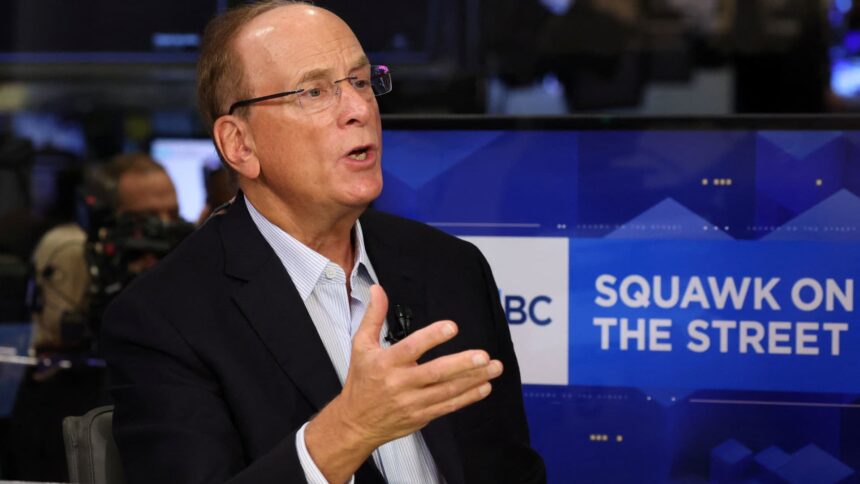
Larry Fink, Chairman and CEO of BlackRock, and Mukesh Ambani, Chairman of Reliance Industries, have recently emphasized the importance of investing in Indian equity markets, urging citizens to reconsider their preference for gold as a means of safeguarding their wealth. This call to action comes amidst growing volatility in gold prices and a notable dip in the Indian stock market, with the Nifty 50 index experiencing a nearly 2% decline this year.
During a recent fireside chat, Ambani pointed out that a significant portion of domestic savings are tied up in gold and silver, describing these investments as “unproductive.” He asserted that channeling funds into the stock market could offer better growth potential, highlighting that these investments have the potential to compound over time. Last year, Reliance Industries, the largest conglomerate in India, entered into collaboration with BlackRock, the world’s largest asset manager, to launch mutual funds in India. Their joint venture, Jio BlackRock Asset Management, introduced its first equity fund in August, and by the end of December, it reported assets under management totaling 31.98 billion rupees (approximately $353 million).
Despite India being one of the largest consumers of gold globally, there is a noticeable trend toward the financialization of savings, with mutual funds gaining traction among Indian investors. According to a report from Bain & Company, the assets driven by retail investors in the Indian mutual fund industry are projected to swell to 300 trillion rupees (about $3.3 trillion) by 2035, compared to 45 trillion rupees anticipated for fiscal year 2025. Currently, a significant portion of Indian households still allocate nearly 59% of their assets in physical forms like gold and real estate, a decrease from 66% a decade earlier.
Fink expressed his optimism for India’s economic future, suggesting that the coming 20 to 25 years will herald an “era of India.” He encouraged Indian citizens to participate in their country’s growth through capital markets. The International Monetary Fund (IMF) supports this perspective, projecting India as the fastest-growing economy globally, with an anticipated growth rate of 6.4% in 2026. In contrast, the global economy is expected to grow by just 3.3%, with major economies like Germany, the U.K., and Japan likely to experience only low single-digit growth.
Fink also drew parallels between India and the historical investment patterns observed in the U.S., indicating that individuals who invested in the growth of the American economy ended up significantly better off than those who merely saved their money in bank accounts. He predicted that the Indian equity market over the next two decades is poised for substantial growth, with potential for returns to double, triple, or even quadruple—contrasting this with his expectations for gold.
Despite foreign investors having sold off Indian equities for over a year, the resilience of the Indian markets can be attributed to a surge in domestic participation. Investment via systematic investment plans (SIPs), which allow individuals to invest smaller amounts regularly, has seen remarkable growth, tripling to 2.89 trillion rupees ($31.9 billion) in the fiscal year 2025 compared to 2021.
Although the year-to-date performance of the MSCI India Index has been lackluster, achieving a dollar return of only 2.61%, it stands in stark contrast to the MSCI Emerging Markets Index, which boasts a return of 43.67%. Nevertheless, the five-year performance of the India index has nearly doubled that of its broader emerging market counterpart, underscoring the long-term growth potential that Fink and Ambani are urging investors to capitalize on.