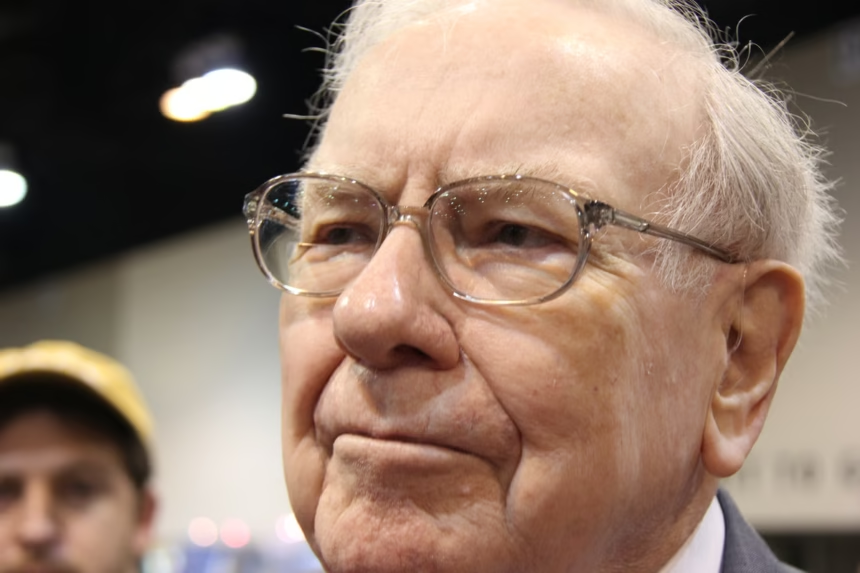
Warren Buffett has officially stepped down as CEO of Berkshire Hathaway, marking the end of an era. Over his remarkable 60-year tenure, Buffett transformed the company from a struggling textile manufacturer into a colossal conglomerate, boasting a diverse range of wholly-owned subsidiaries and a substantial marketable equity portfolio. Under his leadership, the company’s value soared by an astonishing 6,099,294%, significantly outperforming the S&P 500 and generating considerable wealth for countless investors.
As Buffett concludes his time at the helm, a significant warning signal for investors has emerged. Berkshire Hathaway ended 2025 with a staggering $373 billion in cash and Treasuries, a notable increase from $321 billion in 2024 and $129 billion at the end of 2022. This unprecedented accumulation of cash is not an oversight; it is a strategic outcome attributed to Buffett’s substantial stock sales and a marked decrease in new investments. Notably, he sold more stocks than he purchased across the last 13 quarters of his leadership.
Among the most significant transactions during this period were his sales of Apple and Bank of America stocks, both of which had historically delivered exceptional returns for Berkshire. His choice to cash out coincided with the introduction of new tax legislation that reduced corporate taxes to 21%, allowing him to secure gains more advantageously. This strategy is viewed as a method to minimize exposure to the 15% alternative minimum tax over the last two years.
Despite his stock sales, which could have easily been reinvested into repurchasing shares without incurring penalties, Buffett opted to allow cash to accumulate while searching for more appealing investment prospects. This pattern suggests that he perceives stocks like Apple and Bank of America as overvalued, a belief reinforced by their continued high trading levels.
Buffett’s substantial cash reserves act as a cautionary indicator, signaling that he might view most investment opportunities in the market as overpriced. His reluctance to repurchase Berkshire’s own stock during his final 19 months as CEO further underscores this sentiment. In his last shareholder letter, he noted a scarcity of compelling investment options, stating, “Often, nothing looks compelling,” and indicating a preparatory stance for potentially more advantageous times ahead.
Historical market valuation metrics suggest an alarming trend, indicative of current stock overvaluation. Buffett’s preferred metric, the market-cap-to-GDP ratio, is hovering near record highs at 217%. Furthermore, the cyclically adjusted price-earnings (CAPE) ratio, a respected predictor of long-term returns, is currently at 38.8. Historical data shows that whenever the S&P 500’s CAPE ratio exceeded this threshold, it resulted in negative returns over the subsequent decade.
However, it is essential to note that drawing strict conclusions from these figures may be imprudent given the unique circumstances surrounding the dot-com bubble and subsequent financial crises. Buffett, being well-versed in market history and psychology, understands these nuances. Yet he has acknowledged the difficulties of locating attractive investments in the present climate.
For investors, the takeaway remains clear: while it may be prudent to guard against potential market corrections by increasing cash reserves, a complete divestment is not advisable. Notably, Buffett maintained a $300 billion equity portfolio for Berkshire upon his retirement, underscoring his belief that opportunities still exist for those willing to conduct thorough research. Although many high-value stocks may be overlooked by Buffett, those who seek out smaller companies or sectors he traditionally bypassed might still find promising investments.