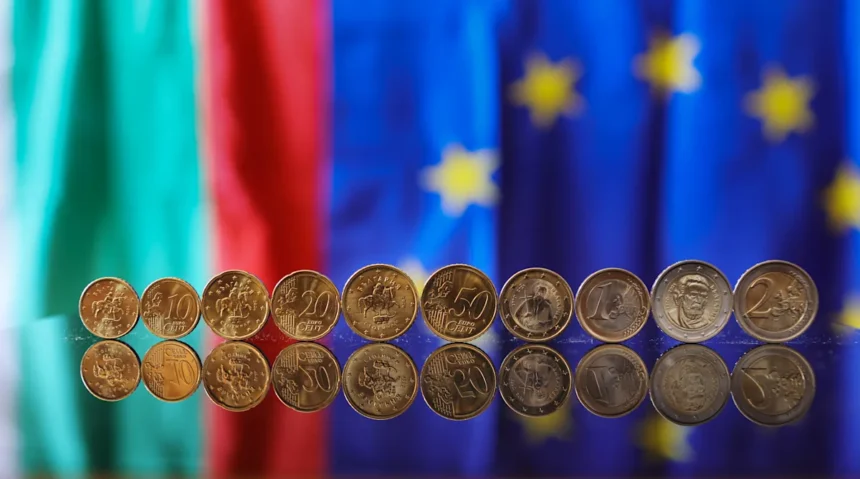
On New Year’s Day, Bulgaria is set to realize a long-held ambition by officially joining the euro currency union, marking a significant step towards enhancing its economic ties with more affluent Western European nations. This transition is anticipated to bolster cross-border trade and encourage foreign investment, a goal the Bulgarian government has diligently pursued for many years. However, as the changeover approaches, polls indicate that skepticism remains prevalent among the populace.
As Bulgaria prepares for this substantial shift, everyday prices and bank account balances will soon reflect both the new euro and the existing lev, fixed at a rate of 51 euro cents per lev. While transactions in levs will still be permissible for an initial month, the currency change will commence, with citizens receiving euros as change. The existing currency will gradually be phased out, with a fee-free exchange option available until June 30 at various financial institutions, including banks and the Bulgarian Central Bank.
Joining the eurozone signifies Bulgaria’s entry into a larger economic framework, which includes a shared currency and a central banking system that governs interest rates across member states. For residents, this new alignment will ease travel within the eurozone, allowing for vacations in neighboring Greece without the need to exchange currency. Furthermore, businesses engaged in intra-eurozone trade are set to save approximately 1 billion levs annually by eliminating currency conversion costs. In addition, Bulgaria will gain a seat on the European Central Bank’s governing council, granting it a say in vital monetary policy decisions.
While membership entails relinquishing certain economic policy tools—such as the ability to devalue the national currency for competitive advantage—Bulgaria had already effectively constrained its economic sovereignty by pegging the lev to the euro in prior years.
Bulgaria’s commitment to transitioning to the euro dates back to its accession to the EU in 2007, although some member states, like Denmark, have managed to negotiate opt-outs, while others such as the Czech Republic, Hungary, Poland, and Romania have not met the necessary criteria for euro adoption.
Despite the economic benefits outlined, public sentiment in Bulgaria reflects considerable hesitation. A recent Eurobarometer poll revealed that over half of the surveyed population opposed euro adoption, largely due to fears of rising inflation and concerns over losing a symbol of national identity. This skepticism is compounded by broader economic uncertainties and a lack of trust in governmental institutions, with Bulgaria consistently ranked as one of the most corrupt nations in the EU and having one of the lowest average income levels.
Public apprehension is further fueled by disinformation campaigns, allegedly linked to Russian interests, that aim to create discord within EU member states. Economists note that historical trends indicate a temporary inflationary spike typically follows currency transitions. The European Central Bank has previously reported an uptick of 0.2% to 0.4%, which tends to diminish over time as public confidence in the new currency stabilizes.
In summary, while Bulgaria’s transition to the euro promises numerous economic advantages and broader integration within Europe, the path ahead remains fraught with challenges stemming from public skepticism, economic anxiety, and the complexities of adapting to a new monetary system. Observers note that over time, as citizens adjust to the euro in daily transactions and recognize the stability offered by the central bank, opinions often shift favorably toward the single currency.