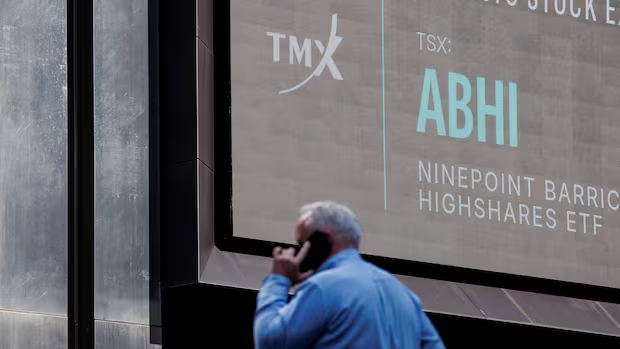
On Friday, both Canadian and U.S. stock markets experienced significant declines, fueled by concerns over the geopolitical turmoil stemming from the ongoing U.S.-Iran conflict and its impact on interest rates. Analysts indicate that heightened energy prices and inflationary pressures have prompted a “risk-off” sentiment across various asset classes, particularly equities.
Dustin Reid, vice-president and chief strategist for fixed income at Mackenzie Investments, highlighted that markets are reacting strongly to the potential for further central bank rate hikes. This phenomenon is reflected in the S&P/TSX composite index, which dropped by 537.57 points to close at 31,317.41. Similarly, the Dow Jones industrial average fell by 443.96 points to 45,577.47, while the S&P 500 and Nasdaq composite also posted losses, with declines of 100.01 points and 443.08 points respectively.
Market apprehensions have led traders to almost completely abandon their expectations that the U.S. Federal Reserve will reduce interest rates this year, as indicated by data from CME Group. In fact, some analysts speculate that the Fed may even consider raising rates as far out as 2026, a notion that seemed improbable prior to the onset of conflict in the region. The prior market sentiment had leaned towards the possibility of at least two rate cuts within the year—a view strongly contested by recent developments.
Reid pointed out that while lower interest rates generally benefit the economy and bolster investment prices, they pose the risk of exacerbating inflation. As a result, investors now perceive limited leeway for central banks worldwide to lower interest rates in an effort to stimulate economic growth. This trend was further underscored by the recent decision of major central banks—including the Federal Reserve, Bank of Canada, and others in Europe, Japan, and the UK—to maintain their interest rates.
In commodity markets, oil prices surged in response to the heightened tension, with the May crude oil contract rising by $2.68 to settle at $98.23 per barrel. The volatility in Brent crude prices has been notable, fluctuating from around $70 per barrel before the onset of conflict to peaks exceeding $119.50 in recent trading sessions. This instability reflects the uncertainty surrounding the duration of the war and potential disruptions to oil and gas production in the Persian Gulf region.
Reid further noted that ongoing elevated oil prices could shift the narrative from a focus on inflation to broader questions regarding global growth and corporate earnings. Should Brent crude prices remain near $120 per barrel over an extended period, the market may have to reevaluate its expectations and trading strategies.
In the Canadian stock market, the majority of sectors reported negative performance, with basic materials being a primary contributor to the downturn. Conversely, the consumer non-cyclicals sector was the only exception, showing modest gains. Despite the pressures on the stock market, the Canadian dollar managed to strengthen slightly, trading at 72.90 cents U.S., up from 72.84 cents the previous day. Reid remarked that the Canadian dollar has maintained a relatively stable performance, benefiting from safe haven inflows amidst the uncertainty in global markets.
Overall, the current geopolitical climate has injected substantial volatility into investment markets, and analysts continue to monitor the situation closely for further developments that could influence economic conditions and monetary policy decisions.