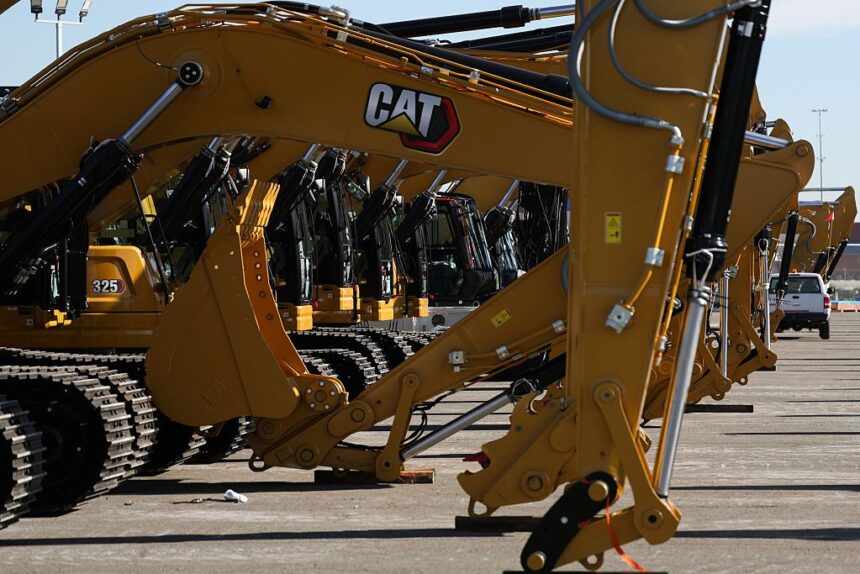
Caterpillar Inc. (CAT), recognized as the world’s leading manufacturer of heavy construction and mining equipment, has solidified its status as a crucial indicator of the global economy. Over the years, the company has managed impressive returns, significantly outpacing the broader U.S. stock market and global economic growth, much to the pleasure of its long-term investors.
While Caterpillar’s history dates back a century, originating from its role in supplying tractors to farmers and New Deal projects, it has successfully evolved to remain relevant. The past two decades have seen the company adeptly navigate substantial cyclical shifts within the global economy, often leveraging market conditions to its advantage. For instance, the China-led commodities supercycle during the early 2000s presented significant opportunities for CAT, which capitalized on the booming demand for construction resources.
Despite its successes, not all of CAT’s decisions have come at the right moment. The acquisition of Bucyrus International, a mining equipment powerhouse, in 2011 occurred essentially at the peak of an industry cycle. This resulted in a prolonged period of subdued stock performance as the market adjusted after the boom. However, this challenge forced Caterpillar to refocus on enhancing operational efficiencies, leading to an expansion in its parts and maintenance division—a sector that delivers higher profit margins compared to the sale of heavy machinery.
In more recent developments, CAT has positioned itself as a significant player in the burgeoning realm of artificial intelligence (AI). This transformation has redefined the company from a traditional tractor manufacturer to a modern critical infrastructure and energy entity. The demand for data centers spurred by the rise of AI has significantly increased the need for construction and related energy solutions, leading mining companies to upgrade their equipment, giving Caterpillar’s latest innovations a competitive advantage.
Moreover, the integration of Internet of Things (IoT) technology has established a recurring revenue model for Caterpillar, whereby the company ensures that customers purchase parts and services exclusively through its dealer network.
Caterpillar, classified as a blue-chip industrial stock, has a reputation for exhibiting cyclical performance patterns. However, the company has maintained a consistent dividend policy, earning a spot as one of the S&P 500 Dividend Aristocrats—making it a reliable option for dividend growth amid market fluctuations.
Over its time as a publicly traded company, Caterpillar has generated an impressive annualized total return of 16.3%, outpacing the broader market by approximately six percentage points. When evaluating historical performance, a hypothetical $1,000 investment in Caterpillar stock made two decades ago would be worth around $17,000 today, in stark contrast to the $7,800 equivalent from the S&P 500 index fund over the same period.
Looking ahead, optimism remains strong among analysts regarding Caterpillar’s future. A recent survey among 29 analysts from S&P Global Market Intelligence reveals a consensus recommendation of “Buy,” reflecting confidence in CAT’s ongoing performance. Notably, Oppenheimer analyst Kristen Owen highlighted the company’s significant exposure to both technological advancements and traditional sectors, describing CAT as underappreciated in its approach to AI in the physical world. Owen pointed to CAT’s robust backlog growth, the durability derived from service sales constituting 40% of revenue, and the ongoing share buyback strategy as fundamental elements paving the way for the company’s next growth phase.
Overall, Caterpillar Inc.’s adaptability and strategic positioning in an evolving market landscape continue to suggest a promising trajectory for future investors.