Central Wisconsinites reliant on federal marketplace health insurance are facing challenging decisions as the expiration of Affordable Care Act (ACA) premium tax credits looms at the end of the year. Dawn Lass, a former teacher from Stevens Point, shared her apprehension as her family’s monthly premium is projected to soar from $500, coupled with a $14,400 deductible, to an alarming $2,475 alongside a $20,000 deductible if the credits are not extended.
“We had no idea this was coming, and so we’re just finagling, trying to find ways to make sure that we’re going to be able to afford this,” Lass expressed. With her family part of the “sandwich” generation, providing care for both aging parents and grandchildren, the financial burden could compel her to return to work, disrupting her ability to support her family during a time of need.
Julia Jiannacopoulos from Coloma, who recently lost her husband, faces a similar plight. She indicated that the tax credit had allowed her to afford coverage that cost about 20% of her income. However, next year’s rates threaten to more than double her expenses. As a result, Jiannacopoulos is contemplating a catastrophic plan that would require her to pay for most of her medical care out of pocket. “My kid has already lost one parent, and I’m going to be around as long as I can, so I’m taking really good care of myself,” she stated.
Enrollment in the ACA has surged, with over 300,000 Wisconsinites signing up for health insurance for 2025, marking a 60% increase since the introduction of the tax credits. The eligibility for these credits was expanded in 2021, allowing more middle-income earners to benefit.
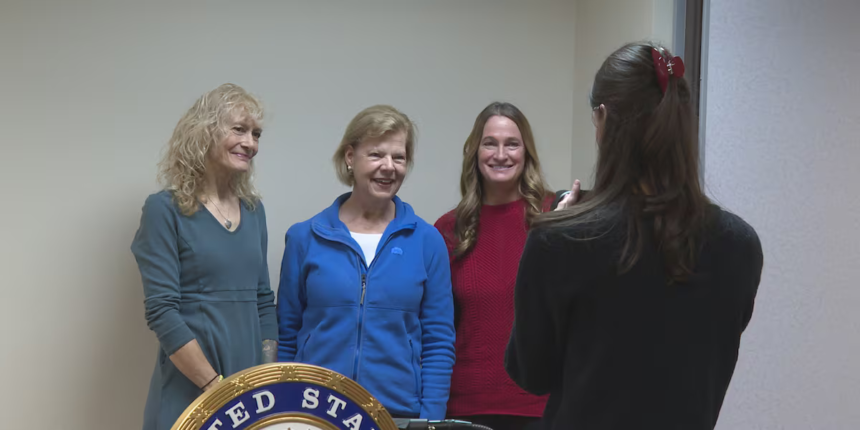
Both Lass and Jiannacopoulos have reached out to lawmakers, including Democratic Senator Tammy Baldwin, to express their concerns. Baldwin facilitated a press conference in Wausau at the Bridge Community Health Clinic, which aims to provide care to patients regardless of their insurance status. Executive Director Jennifer Smith shared her emotional response to hearing personal stories of struggle. “Even though we hear this every day, I couldn’t help but tear up in thinking, like these are the choices that people are really making in their lives,” Smith said.
The clinic, which serves around 4,000 patients annually, is bracing for a potential increase in uninsured patients should the tax credits expire. Smith anticipates the need for uninsured rate adjustments could place additional strain on the clinic’s finances. With grant revenue constituting a significant portion of the clinic’s budget, any increase in patient numbers without insurance could hinder its operational capabilities, leading to cuts in programs and services designed to promote health equity.
Senator Baldwin noted the urgency of the impending deadline, calling for bipartisan support to extend the tax credits. She highlighted interest from some Republicans in resolving the issue but underscored the necessity of collaboration, stating, “I don’t think Ron Johnson is going to be one of them.” Her comments came as Republican Representative Tom Tiffany criticized the ACA, citing a substantial increase in premiums and deductibles since its implementation. Tiffany characterized the Democratic tax credits as a temporary fix rather than a genuine solution, arguing for more comprehensive reforms that foster competition and transparency in health care.
In parallel, Representative Derrick Van Orden echoed the need for long-term solutions, criticizing the temporary nature of enhanced subsidies and advocating for reforms that align with the original intent of the ACA to provide truly affordable health care options. Both representatives, along with other voices in the GOP, continue to push for reforms aimed at reducing costs rather than relying on federal subsidies to maintain coverage levels.
As the deadline approaches, constituents and health care providers alike remain apprehensive about the potential consequences for those dependent on the ACA, highlighting the critical need for swift legislative action.