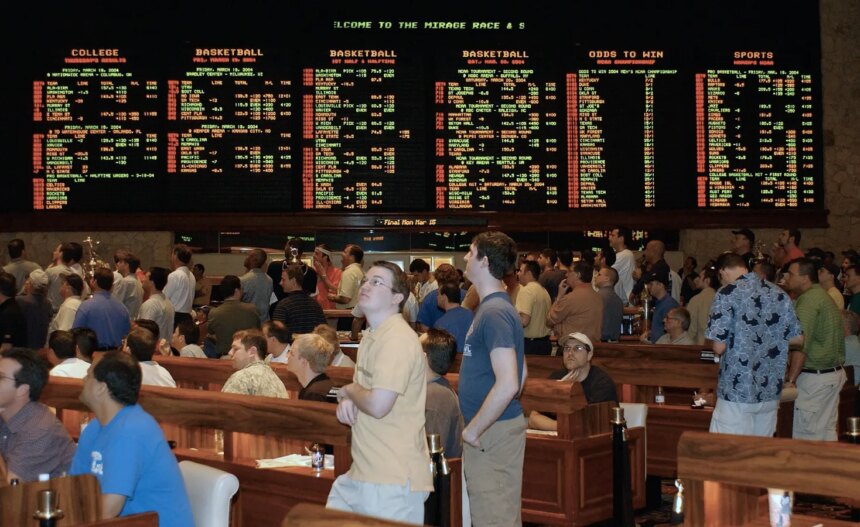
The Nevada Gaming Commission has raised alarms that sports bettors at the MGM Mirage Race & Sports Book are increasingly utilizing prediction markets like Crypto.com’s OG, Kalshi, and Polymarket, asserting that this constitutes illegal gambling. Meanwhile, the Commodity Futures Trading Commission (CFTC) has intervened, arguing in court that these platforms offer legal event contracts that fall under federal jurisdiction, thereby superseding state regulations.
In a significant Ninth Circuit appeal—North American Derivatives Exchange, Inc. et al. v. The State of Nevada—Crypto.com, operating under the name NADEX, is contesting restrictions imposed by the Nevada Gaming Control Board (NGCB) on its prediction markets platform. The CFTC, demonstrating a strong stance in this legal confrontation, submitted an amicus brief that claims exclusive federal jurisdiction over exchange-listed event contracts, positioning itself against the Nevada regulators.
Rob Schwartz, a partner at law firm Morgan Lewis and a former counsel for the CFTC, described the current scenario as unprecedented. “This has never happened before. The fence line between federal regulation of derivatives and state regulation of gambling has been contested for decades,” he noted. Schwartz emphasized that the ongoing nationwide litigation has created an opportune environment for this conflict between federal and state regulators.
CFTC Chair Mike Selig heightened the visibility of the agency’s position through a Wall Street Journal op-ed titled “States Encroach on Prediction Markets,” and appeared on Fox Business to clarify the federal agency’s stance. “Well-known CFTC-registered exchanges…face an onslaught of state-driven litigation across the country,” Selig said, criticizing state overreach that threatens CFTC’s jurisdiction over these markets.
Commentators such as Schwartz have also pointed out that if states were permitted to regulate prediction markets, it could lead to an unpredictable regulatory landscape that contradicts the purpose of exclusive federal jurisdiction. The case has broader implications for the distinction between sports prediction markets and traditional sports gambling, which encompasses various events beyond just sports, such as elections and economic indicators.
Former New Jersey Governor Chris Christie, now a strategic advisor to the American Gaming Association, countered these federal claims, asserting that prediction markets lack regulation and pose risks to the integrity of sports and state revenues. During an appearance on CNBC’s “Squawk Box,” Christie stated, “What’s going on with Kalshi and Polymarket now is they’re violating laws in all 50 states.” He characterized these platforms as merely unregulated bets and criticized the CFTC’s initiatives as an encroachment on state rights.
The scope of the legal battle seems poised to escalate, with speculation that it may reach the Supreme Court. Schwartz noted the increasing involvement of federal appeals courts and state supreme courts could lead to significant divisions in rulings, setting the stage for a potentially landmark decision. “All roads appear to lead to the Supreme Court,” he said, underscoring the economic interests and federalism concerns intertwined in this dispute.
The prediction markets segment has witnessed enormous growth, with a reported trading volume of $63.5 billion in 2025, far outpacing traditional derivatives. A favorable ruling for Crypto.com could spark significant expansion in the sector, with billions in new volume anticipated if federal preemption is upheld. Conversely, prolonged uncertainty stemming from a Supreme Court battle could hinder investment, as outlined in a recent TD Cowen report.
A timeline of key developments outlines the progression of the case since September 2025, documenting the NGCB’s cease-and-desist order against Crypto.com and subsequent legal actions, culminating in an upcoming oral argument scheduled for April 2026. With substantial revenues at stake, the outcome of this legal confrontation could reshape the landscape of prediction markets and the regulatory frameworks governing them.