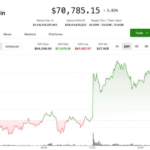
Bitcoin’s recent price movements took a dramatic turn on Sunday, as a significant wave of sell orders from large holders, often referred to as “whales,” triggered a rapid decline of $2,000. This episode not only caused mass liquidations among traders but also led to a swift rebound, raising concerns about the potential for market manipulation, particularly in a low-liquidity environment.
During a pivotal one-hour timeframe, over 15,565 BTC, equivalent to approximately $1.39 billion, flooded the market. Analysts identified coordinated sell-offs from multiple sources: a substantial 4,551 BTC was released by one whale, alongside contributions from exchanges like Coinbase, Wintermute, Binance, and Fidelity, among others. This combined effort precipitated Bitcoin’s fall from around $89,700 to $87,700, establishing a cascade of liquidations across the trading landscape.
As the price plummeted, a staggering $171 million worth of Bitcoin longs were liquidated, caught off-guard by the rapid decline. Although the Bitcoin price later recovered to approximately $91,494, the volatility had already wreaked havoc: in the same hour, nearly $14 million in short positions were also wiped out, compounding the losses from earlier in the day.
The scale of the liquidations was telling, with data indicating that 121,628 traders were liquidated over a 24-hour period, culminating in total liquidations reaching $346.67 million. Many market commentators viewed this situation not as typical market volatility, but rather as “engineered liquidity collection,” where large players manipulate prices to profit from both sides of the market.
Traders noted how quickly the price absorbed the dip, suggesting that demand at the spot price remains robust, despite the aggressive liquidation activity occurring during weaker trading periods. One trader highlighted the abnormality of the rapid recovery, emphasizing that it indicates strong underlying demand.
While Bitcoin has shown resilience in recovering from its recent losses, it continues to experience significant stress during intraday trading. The high volume of liquidations underscores the vulnerability of order books, especially during weekends when market activity tends to thin out. Analysts noted that this could make the market particularly attractive for large participants capable of orchestrating significant price shifts.
Looking ahead, Bitcoin’s ability to maintain its position above $90,000 will be tested in the coming days. The current environment, characterized by over $300 million in liquidations, has cleared out much of the leverage in the market, yet it also leaves Bitcoin particularly sensitive to further movements prompted by whale activity. There is concern that if Bitcoin’s price ascends to around $93,000, approximately $1 billion in short positions could be at risk of liquidation, further complicating the market’s dynamics, as this threshold is only a slight 2% increase from current levels.