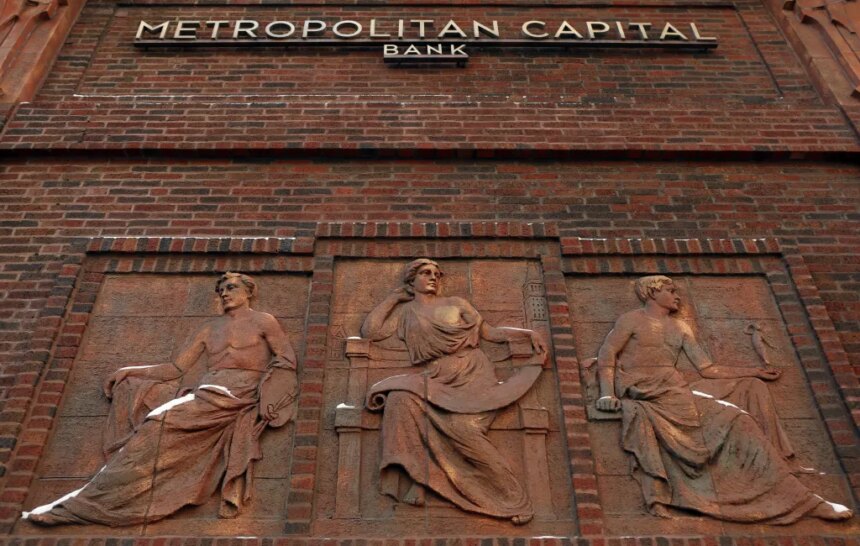
For the second consecutive year, Chicago witnessed the first bank failure in the nation as Metropolitan Capital Bank & Trust was closed by the Illinois Department of Financial and Professional Regulation (IDFPR). Citing “unsafe and unsound conditions and an impaired capital position,” the regulatory body took action on Friday, resulting in the appointment of the Federal Deposit Insurance Corporation (FDIC) as the receiver.
In a swift move, the FDIC entered into a purchase agreement with First Independence Bank, a financial institution based in Detroit, which reopened the failed bank on the following Monday. “We want to be clear that no depositor will lose any money as a result of this action,” stated Susana Soriano, the acting director of IDFPR’s Division of Banking, in a news release.
Metropolitan Capital Bank & Trust reported total assets of $261 million and deposits totaling $212 million. Under the terms of the agreement, First Independence Bank agreed to acquire “substantially all deposits” and purchased $251 million of the assets from the failed bank. The FDIC will retain the remaining assets for future disposition, estimating that the overall failure will cost its Deposit Insurance Fund approximately $19.7 million. However, this number may fluctuate as the retained assets are sold off.
Founded in 2005, Metropolitan Capital Bank & Trust was marketed as a Universal Bank, endeavoring to offer a diverse range of financial services on a single platform, particularly to small- and medium-sized enterprises. It claimed to be the sole boutique Universal Bank in North America tailored for this demographic.
First Independence Bank, in operation since 1970, champions financial services for underserved and minority communities, particularly in the Detroit area, and holds the distinction of being Michigan’s only African American-owned bank. “First Independence Bank is well-positioned to continue essential banking services for Metropolitan Capital Bank & Trust customers,” Soriano affirmed in the release.
This closure marks a troubling trend for Chicago, which experienced the first of only two bank failures in the United States last year when Pulaski Savings Bank succumbed to regulatory action in January 2025. Its assets and deposits were transferred to Millennium Bank. The trend continued with the failure of Santa Anna National Bank in Texas later that year.
Prior to the recent failures, Chicago had enjoyed a nearly decade-long period without a bank closure. However, 2017 saw two significant failures, including Seaway Bank and Trust, which was implicated in a politically connected scandal, and Washington Federal Bank for Savings, which collapsed amid an extensive embezzlement scheme. The fallout from the scandal led to criminal charges against 16 individuals, including prominent bank officials and a former Chicago Alderman, while other repercussions included the tragic suicide of the bank’s CEO shortly before the institution was shuttered.