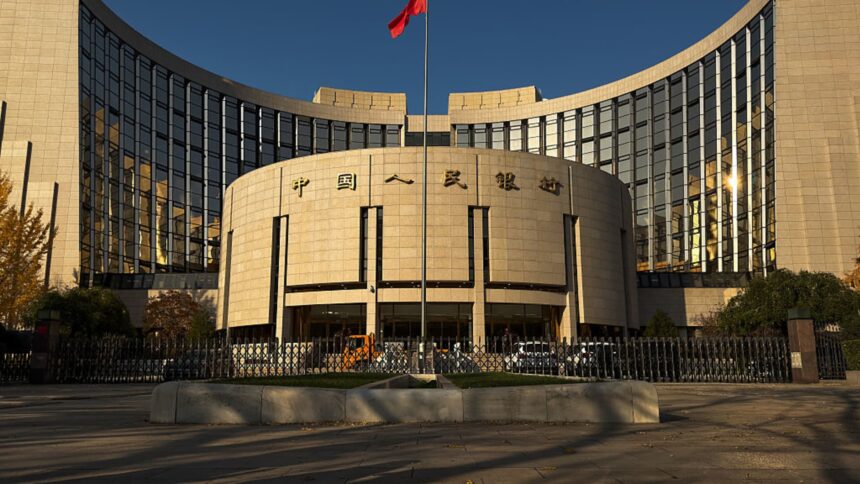
China’s central bank, the People’s Bank of China (PBOC), has opted to maintain the country’s loan prime rates, holding steady despite ongoing economic challenges. In a decision consistent with market expectations, the PBOC kept the 1-year loan prime rate at 3% and the 5-year loan prime rate at 3.5%, marking a seventh consecutive meeting without change.
This decision occurs amidst a backdrop of disappointing economic indicators for November. Retail sales recorded a modest increase of just 1.3% year-on-year, falling short of the anticipated 2.8%. This represents a decline from the previous month’s growth rate of 2.9%. Similarly, industrial production showed only a 4.8% rise compared to the same period last year, also below the forecasted 5%, indicating the slowest growth since August 2024.
The protracted downturn in China’s property market continues to be a significant drag on the economy. Investment in fixed assets, which includes real estate, experienced a contraction of 2.6% from January to November compared to the previous year, surpassing economists’ expectations of a 2.3% decrease. Additionally, home prices in major cities like Beijing, Guangzhou, and Shenzhen fell by 1.2% for new properties, while resale prices registered a steeper decline of 5.8%.
Experts have weighed in on the PBOC’s decision to pause monetary policy changes, emphasizing the necessity for increased stimulus to counteract the weak economic landscape. Eswar Prasad, a professor at Cornell University, acknowledged that some monetary stimulus could be beneficial; however, he cautioned that it may not gain sufficient traction amid current private sector weakness. He suggested that a combination of monetary and fiscal stimulus, along with broader reforms, is crucial for fostering growth momentum.
In response to these challenges, China’s finance ministry recently announced plans to issue ultra-long-term special government bonds in the upcoming year. The intention behind this initiative is to finance key projects and bolster infrastructure development. Additionally, policymakers have committed to enhancing consumption support strategies, particularly in light of deflationary pressures hitting the economy.
On an international front, an interim trade agreement with the United States, which involves suspending significant tariffs on Chinese exports, offers a glimmer of optimism. This development may assist China in achieving its target of approximately 5% economic growth for 2025, with the potential for increased exports to the U.S.
In the financial markets, the Mainland China’s CSI 300 index edged up by 0.43%. Currency exchanges reflected minor variations, with the onshore yuan remaining stable at 7.04 against the dollar, while the offshore yuan experienced a slight weakening, trading at 7.03 per dollar.