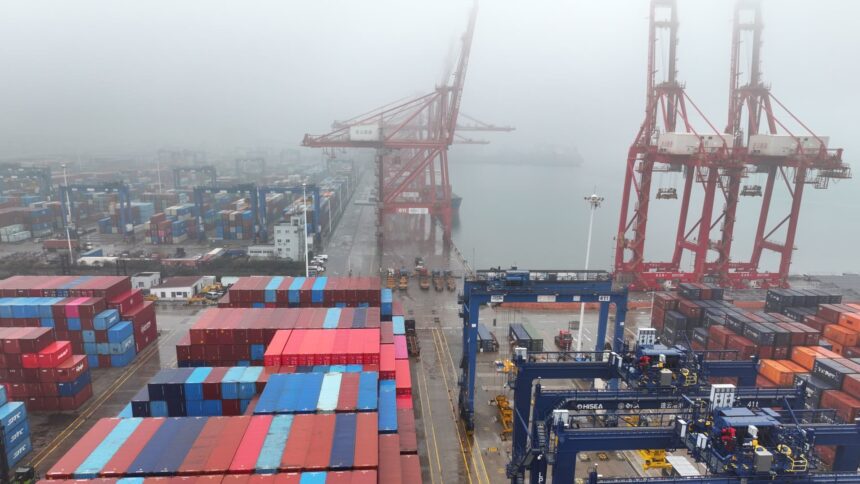
A cargo ship docked at a berth in Jiangsu Province’s Lianyungang Port Container Terminal was observed actively loading and unloading containers on March 1, 2026. Meanwhile, recent data reveals that China’s manufacturing sector has encountered significant challenges, as factory activity slowed down markedly in February. This decline is attributed to manufacturers halting production and cargo shipments in observance of an extended holiday, according to an official survey released by the National Bureau of Statistics (NBS).
The official manufacturing purchasing managers index (PMI) fell to 49 in February, missing economists’ expectations of a slight increase to 49.1. A PMI reading below 50 indicates contraction in the sector, suggesting that the situation has deteriorated for the second consecutive month, mirroring levels seen in October and April of 2025. For context, the official PMI registered at 49.3 in January after a brief rebound in December.
In addition to the manufacturing PMI, the composite PMI, which provides a broader overview by encompassing both manufacturing and service sectors, also declined, dropping to 49.5 from 49.8 in January. The non-manufacturing PMI, which specifically covers services and construction, fell slightly to 49.5, down by 0.1 percentage point.
Huo Lihui, the chief statistician at NBS, explained that the downturn can be primarily attributed to the holiday-induced slowdown, specifically linked to the Lunar New Year celebrations. This year’s holiday spanned from February 15 to February 23—the longest duration recorded—contrasting with the previous year, which saw an eight-day holiday in late January to early February.
In contrast, a private survey conducted by S&P Global indicated a sharp rebound in manufacturing activity, with the RatingDog China General Manufacturing PMI climbing to 52.1 in February—marking the highest level since December 2020. This uptick was fueled by a notable increase in new export orders, highlighting a significant surge in international demand. According to the report, the pace of new export orders rose to the fastest rate since September 2020.
It is important to note that the private survey examines a smaller sample of export-focused manufacturers and is conducted mid-month, while the official NBS poll encapsulates a larger sample size of over 3,000 firms and is finalized at month-end.
Preliminary data suggested increases in travel, entertainment spending, and duty-free shopping during the holiday season. The release of consumer and producer inflation figures for February is anticipated on Monday, adding further insight into economic conditions.
China’s economy, the world’s second largest, has been struggling with deflationary pressures since the end of the pandemic, facing setbacks from a prolonged property downturn and a weak job market. Analysts expect that during an upcoming parliamentary meeting, the Chinese government may announce a revision to its economic growth target for the year, likely adjusting it to a range of 4.5% to 5%, down from the previous target of “around 5%” maintained over the past three years.
The forthcoming economic-planning meeting will provide clarity on Beijing’s policy direction going forward. Zhiwei Zhang, president and chief economist at Pinpoint Asset Management, anticipates that the government may implement moderate boosts to investment should growth momentum show further signs of weakening.