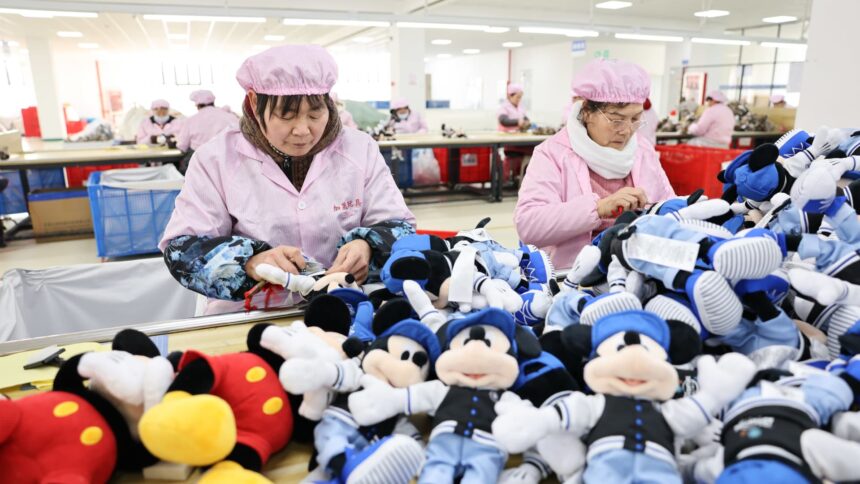
In an encouraging sign for the Chinese economy, the country’s manufacturing activity rebounded in March, climbing more than analysts had anticipated. The Manufacturing Purchasing Managers’ Index (PMI) rose to 50.4, surpassing economists’ expectations of 50.1, as reported by the National Bureau of Statistics. This figure represents a significant turnaround from two months of declines, with January and February registering readings of 49.3 and 49.0, respectively. Notably, the PMI reading of 50 marks the dividing line between expansion and contraction, with March’s performance indicating renewed growth.
The rebound in manufacturing activity is attributed to factories hastily ramping up production following a lengthy national holiday in mid-February. Huo Lihui, chief statistician at the National Bureau of Statistics, highlighted that strong momentum in export orders contributed to this positive momentum. Within the latest PMI data, sub-indexes indicated that production and new orders were expanding, although metrics for raw materials inventory, employment, and delivery times continued to exhibit contraction.
In addition to the positive manufacturing outlook, the non-manufacturing PMI, which reflects activity in the services sector, also showed improvement, climbing to 50.1 from 49.5 in February. However, challenges linger due to rising shipping fees and the increased cost of imported commodities, driven by ongoing conflicts in the Middle East. These conditions have placed additional pressure on manufacturers, with price indexes for raw material inputs and factory-gate prices increasing by 63.9% and 55.4%, respectively.
Despite these disruptions, many manufacturers expressed optimism that the challenges would be temporary, especially with the anticipated visit of U.S. President Donald Trump to China in May to meet with Chinese leader Xi Jinping. Cameron Johnson, a senior partner at Tidalwave Solution in Shanghai, remarked that while the situation remains delicate, there is an expectation that elevated prices and supply constraints may not last much longer.
Moreover, inquiries for Chinese-made solar panels and batteries have reportedly surged from overseas buyers, particularly in Europe, India, and East Africa. This indicates a robust international demand for Chinese exports, which saw a substantial increase of 21.8% in the first two months of the year compared to the same period last year. The strong demand from Southeast Asia and Europe effectively counterbalanced a decline in shipments bound for the United States.
Looking ahead, a separate PMI report from RatingDog and S&P Global is set for release, with expectations that it may indicate a slight decline to 51.6, down from a five-year high of 52.1 in February. Despite potential fluctuations, the overall outlook for Chinese manufacturing appears to be on an upward trajectory as the industry adapts to external pressures.