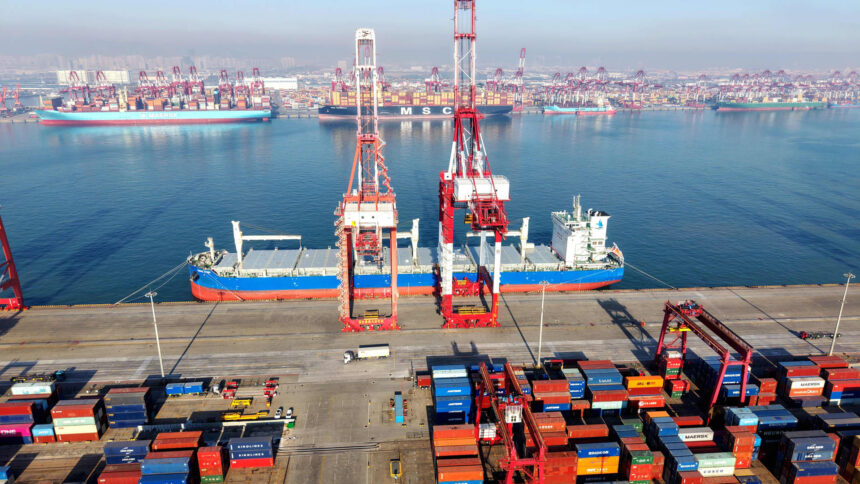
A recent report revealed that China’s trade surplus soared to an all-time high during the combined January-February period, highlighting the country’s economic resilience in the face of ongoing trade tensions with the United States. This surge marked a significant leap to $213.62 billion, surpassing economist expectations of $179.6 billion.
According to customs data released Wednesday, exports from China surged by 21.8% year-on-year for the first two months of 2026, vastly outpacing the anticipated 7.1% growth. Imports also saw a notable increase of 19.8%, exceeding projections of 6.3%. The usual practice of combining January and February data serves to smooth out fluctuations caused by the Lunar New Year holiday.
Despite the overall positive trade numbers, trade with the U.S. fell sharply, declining by 16.9% to 609.71 billion yuan (approximately $88.22 billion) compared to the same timeframe last year. In contrast, trade with the European Union and the Association of Southeast Asian Nations (ASEAN) experienced substantial growth, with exports to the EU increasing by 19.9% to 998.94 billion yuan, and trade with ASEAN rising by 20.3% to reach 1.24 trillion yuan.
The surge in trade figures comes alongside a notable rise in consumer inflation in China, which recorded its largest increase in over three years. This inflationary uptick, largely attributed to consumer spending during the extended holiday period, was somewhat expected given the timing of the Lunar New Year this year. Zhiwei Zhang, president and chief economist at Pinpoint Asset Management, noted that while the holiday likely influenced the figures, it did not fully account for the unexpected performance.
In light of the robust export numbers and a conservative GDP growth target of 4.5% to 5% set during the annual “Two Sessions” policy meetings, experts suggest that further economic stimulus is unlikely in the near future. The target is the lowest since the early 1990s.
February’s Consumer Price Index (CPI) rose by 1.3% from the previous year, exceeding forecasts of a 0.8% increase. This marked a strong rebound following a minimal rise of 0.2% in January, reflecting improved consumer sentiment and spending.
During the “Two Sessions” meeting, Premier Li Qiang acknowledged the ongoing impact of U.S. tariffs on the Chinese economy, as both nations continue to grapple with trade disputes. The trade war, which escalated after former President Donald Trump took office in January 2025, has seen both countries adjusting tariffs on one another’s goods. Relations bore a glimmer of hope following a meeting between Trump and Chinese President Xi Jinping during the APEC summit in Busan, South Korea, in October.
Currently, U.S. tariffs on Chinese imports stand at an average of 10%, following a Supreme Court ruling that nullified Trump’s tariffs implemented under the International Emergency Economic Powers Act. However, earlier tariffs from various trade acts remain active for certain products, with effective rates for many goods shipped to the U.S. still hovering around 30%, the highest compared to other countries.
As the economic landscape evolves, experts and policymakers will continue to monitor these trends, assessing their implications for China’s future trade and economic growth trajectory.