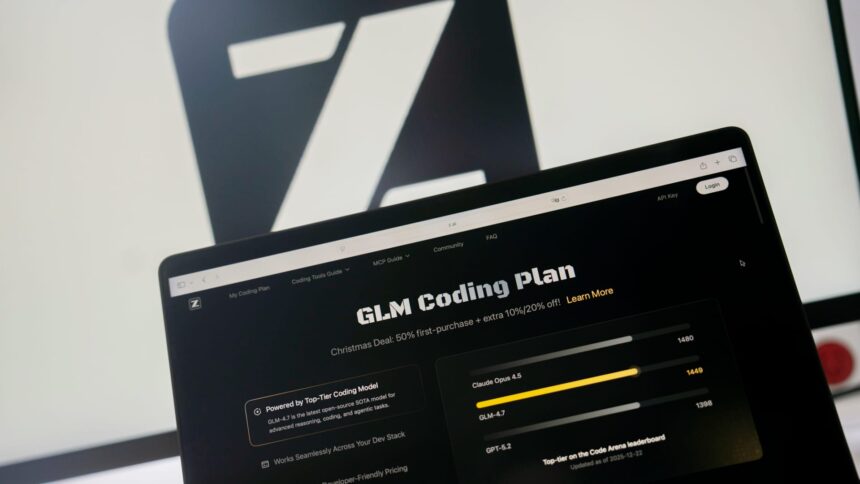
Chinese artificial intelligence stocks experienced a significant rally Thursday, driven by the unveiling of upgraded models from several companies and renewed support from top policymakers for broader adoption of AI technologies. Among the most notable performers was Zhipu AI, which trades on the Hong Kong stock exchange as Knowledge Atlas Technology. The company’s shares surged by 30% following the launch of its latest open-source large-language model, GLM-5, which features improved coding capabilities and long-duration agent tasks. Zhipu AI claims that GLM-5 nearly matches Anthropic’s Claude Opus 4.5 in coding benchmarks and outperforms Google’s Gemini 3 Pro in certain tests, although CNBC could not independently verify these assertions.
Another notable rise came from MiniMax, whose stock increased by 11% after releasing the M2.5 open-source model equipped with advanced AI agent tools. This new model focuses on enhancing coding and agent-centric workflows, highlighting the competitive landscape as Chinese developers strive to catch up with U.S. counterparts through an influx of new model releases.
The broader sentiment surrounding AI stocks was buoyed further by the performance of UCloud Tech, whose shares, primarily due to its support role for Zhipu, spiked by 20% to reach the daily trading limit. SenseTime, which has pivoted from its original focus on facial recognition technologies to offering AI software solutions, saw its stock increase by 5%.
The Shanghai STAR AI Industry Index climbed by 1.7% before reducing some of its gains. DeepSeek, which gained traction last year, recently upgraded its flagship AI model, introducing support for larger context windows and incorporating more current knowledge. Ant Group also joined the launch surge with its new open-source AI model, Ming-Flash-Omni 2.0, designed as a “unified multimodal model” capable of generating speech, music, sound effects, and visuals. Additionally, ByteDance launched an updated version of its AI video generation app, Seedance 2.0, which contributed to a rally in Chinese AI application stocks.
Chinese Premier Li Qiang emphasized the need for a comprehensive strategy to promote the scaled and commercialized application of AI technologies. His remarks called for improved coordination of power and computing resources to facilitate advancements in the sector. Li also highlighted Beijing’s intentions to foster a supportive environment for AI talent and the companies involved.
Despite the surge in pure-play AI startups, traditional Chinese tech giants with AI segments faced challenges, with shares of Tencent and Alibaba declining by 2.6% and 2.1%, respectively. The Hong Kong Hang Seng Tech index also fell by 1.7%.
On Wall Street, the AI sector has shown increased volatility, with investors shifting between excitement over the transformative potential of AI and concerns regarding inflated valuations. Tai Hui, APAC chief market strategist at JP Morgan, commented on CNBC, stating that fears of an AI bubble might be premature, noting that many strong players in the field are supported by solid fundamentals.
Analysts have observed that Chinese tech companies are adopting a more cautious approach to AI investment compared to their American counterparts, focusing more on domestic market growth with less capital expenditure involved in their development strategies.