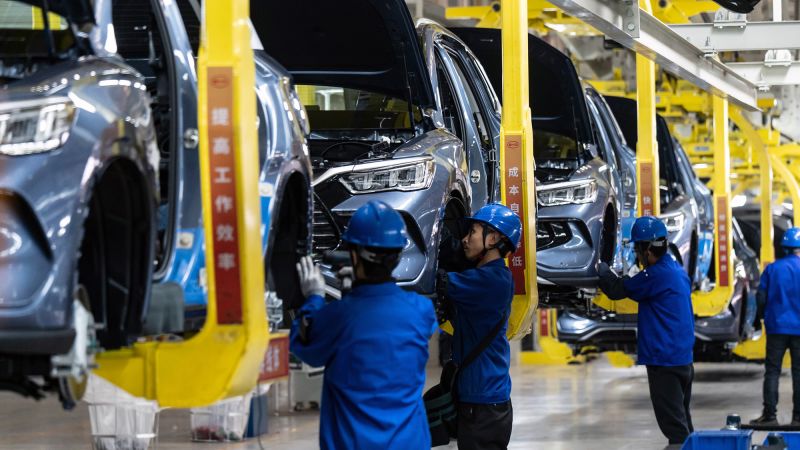
Chinese automakers are poised to make a significant entry into the American market in the coming years, with predictions suggesting that their vehicles could soon be available at U.S. dealerships. This shift is anticipated to offer U.S. consumers more choices, particularly in the electric vehicle (EV) sector, which is becoming increasingly competitive.
Currently, Chinese companies dominate global vehicle production and exports, yet tariffs and strained U.S.-China relations have kept them from gaining a foothold in the American automobile market. Experts, however, indicate that these barriers may soon be overcome, with plans in motion for Chinese auto manufacturers to establish production facilities in the U.S. rather than export vehicles directly from China.
Lei Xing, an independent auto analyst, noted that several Chinese automakers are eager to invest in the U.S. market and set up manufacturing operations. This potential influx aligns with a broader economic narrative that suggests increased competition can lead to consumer benefits, such as lower prices and enhanced selection, particularly in the EV market. However, this could pose challenges to existing car companies in the U.S., affecting their profits and market shares, as well as the jobs of nearly a million American workers in the auto sector.
Currently, vehicles imported from China are subject to a steep tariff of 100%, the highest rate for any imported goods. Despite this, U.S. political dynamics are shifting, with notable support for welcoming Chinese automotive investments when they involve job creation. Former President Donald Trump recently articulated a more welcoming stance toward Chinese brands willing to build factories in the U.S., highlighting the potential economic benefits.
China’s automotive industry has been experiencing robust growth, producing one-third of the world’s cars and exporting over 8 million vehicles last year alone. The increasing competitiveness of Chinese automakers, especially in the electric vehicle sector, has made them formidable players on the global stage. The Chinese company BYD has recently overtaken Tesla as the world’s largest electric vehicle manufacturer.
Although establishing a manufacturing plant in the U.S. can be a lengthy process, experts believe many Chinese automakers are actively planning their market entries. The U.S. automotive market remains an attractive arena due to its wealthier consumer base and preference for larger, high-value vehicles, making it potentially more profitable compared to other regions.
Chinese companies have already begun exploring opportunities in the U.S. automotive market. For instance, Geely, which owns Volvo, has a manufacturing plant in South Carolina that is currently expanding and could facilitate the introduction of additional brands such as Zeekr and Lynk & Co. The company appears to be gearing up for deeper engagement in the U.S. market, with announcements anticipated in the next couple of years.
As car prices in the U.S. reach record highs, the arrival of Chinese brands could foster greater competition, potentially lowering prices for consumers. This scenario mirrors trends observed in Europe, where the entry of Chinese automakers has had a similar effect.
Despite this potential, challenges remain for Chinese brands as they seek to win over American consumers who might be hesitant about unfamiliar brands. However, experts argue that as long as the vehicles provide good value and quality, American consumers will prioritize performance over brand origin, thus presenting a viable opportunity for success in the U.S. market.
Ultimately, if Chinese automotive brands can address the market’s demands for quality and affordability, they stand a strong chance of not only breaking into the U.S. market but thriving in an increasingly competitive landscape.