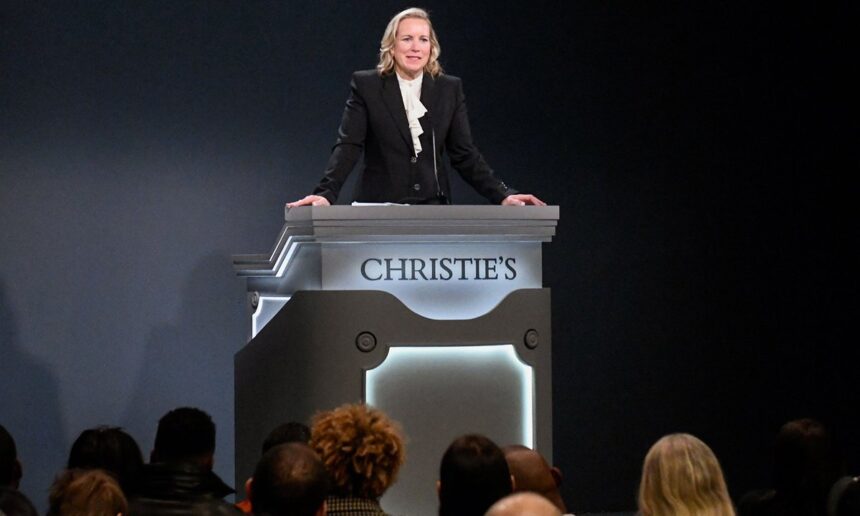
In the first half of 2025, Christie’s auction house generated impressive sales of approximately $2.1 billion, maintaining a steady performance compared to the previous year, according to newly appointed CEO Bonnie Brennan. This period has been characterized by global geopolitical uncertainties and ongoing conflicts, which Brennan has noted require a focus on continuity and commitment to strategic goals. Though there was a minor decrease of 2% in sales from the 20th- and 21st-century art categories, luxury sales surged by an impressive 29%.
Sotheby’s reported similar sales figures, raising about $2.2 billion in the same timeframe, slightly down from $2.3 billion in the prior year. This relative stability comes after a significant 22% drop in sales experienced by Christie’s in the first half of 2024, prompting industry analysts to question whether the decline has finally reached its low point.
Art market expert Philip Hoffman opines that the downturn is a passing phase, noting he has seen several market fluctuations over his career. He cautions that the high transaction costs currently deter affluent buyers, leading them to approach art sales with more financial scrutiny. In response to these dynamics, Hoffman, along with four other prominent figures in the art sector, has launched New Perspectives Art Partners, which aims to facilitate lower-risk, lower-cost private art sales.
Despite these efforts, a crucial inquiry persists: if wealthy individuals are adopting more financial perspectives, why continue investing in art? Data collected by Michael Moses, co-founder of the Mei Moses Art Index, indicates that over half of auctioned lots resulted in negative compound annual returns during the first half of 2025. This trend represents the worst financial performance for auctions in the 21st century, with Moses attributing the stagnation in the art market to impressive returns seen in stocks, gold, and cryptocurrencies.
Recent financial data further illustrates the growing allure of alternative investments. The S&P 500 index saw a 5.1% increase, gold prices rose by 25.1%, and Bitcoin increased by 9.1% during the same period. BlackRock’s Bitcoin Trust ETF has attracted $84 billion in funds, surpassing even the total estimated sales for the global art market last year.
On the other hand, landmark sales have continued to captivate collectors. A Canaletto painting fetched $43.9 million shortly after Jeff Bezos’s lavish wedding in Venice, while other significant sales include a Rosebud sledge from “Citizen Kane” for $14.7 million and a juvenile Ceratosaurus fossil that sold for $30.5 million. Such purchases underline the continuing appeal of unique collectibles to the ultra-wealthy.
However, prominent art dealers are expressing concerns about the health of the market. Tim Blum, who recently shuttered his gallery, remarked that the existing system has struggled for years, claiming dwindling meaningful conversations at major art fairs. Similar sentiments were echoed by other galleries that have also closed, indicating that events like Art Basel are increasingly seen as social gatherings for a select group rather than effective marketplaces.
The shifting nature of art fairs reflects a broader trend where possession of significant artworks is less about financial gain and more about personal status and enjoyment. Alain Servais, a prominent collector, predicts ongoing contraction in various art market segments, suggesting that while art sales may decline in revenue, the volume of artworks sold is unlikely to diminish significantly. Only masterpieces are expected to attract serious interest, as younger generations are less drawn to the once-coveted works of older collectors.
Former Art Basel director Marc Spiegler has advocated for a shift in how the art market is perceived, recommending that the focus pivots towards art that excites cultural engagement rather than merely serving as investment vehicles. This new approach envisions art as a pleasurable experience for a select few who appreciate culture and intricacy, rather than as a financial asset burdened by opacity and high costs.
As the art market continues to evolve in response to these dynamics, the challenge remains for industry figures to redefine the value of art amidst shifting financial interests and changing social landscapes.