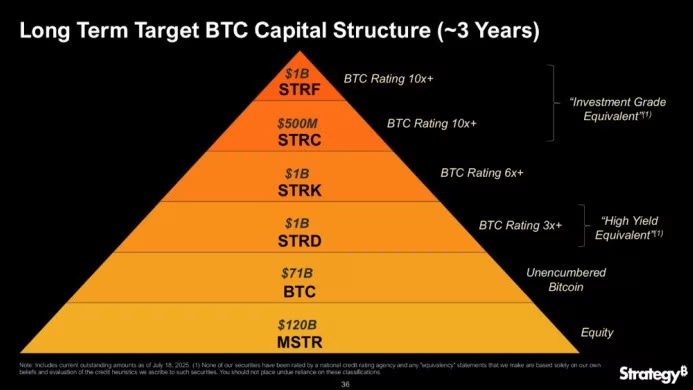
In a recent analysis, analysts initiated coverage on MicroStrategy (MSTR) with a Buy/High Risk rating, assigning a target price of $485. This target is underpinned by Citi’s forward 12-month Bitcoin forecast, which estimates Bitcoin could reach $181,000, representing a potential upside of 63% from current levels. Analysts also believe MSTR’s net asset value (NAV) premium, which could be between 25%-35%, reflects its historical performance, allowing for a projected Bitcoin yield multiple between 2.5x to 3.5x, assuming the ongoing positive trend of Bitcoin persists.
MSTR’s primary function has been as a Digital Asset Treasury (DAT) company, making its stock a highly leveraged and volatile investment associated with Bitcoin. The company’s performance could yield substantial returns in a bullish scenario but may also result in sharp losses if the cryptocurrency’s price declines. In a bear case scenario, where Bitcoin’s price drops approximately 25%, the analysts caution that MSTR’s stock could see a staggering decline of up to 61%, based on the assumption of a corresponding shift in its NAV premium from 35%-40% to -10%.
While this analysis acknowledges the circular references inherent in pricing—where a higher MSTR relative to Bitcoin leads to an increased NAV premium that, in turn, boosts Bitcoin yield—this dynamic creates a feedback loop that can drive both the stock and cryptocurrency upwards. However, the opposite may occur in a bearish environment where declines could amplify the risks.
There are concerns regarding the valuation of MSTR’s software business, estimated at $1 billion, which appears to be lacking in growth and profitability, leaving its cash flow contributions inadequate for bolstering the company’s Bitcoin acquisition strategy. Given this context, the focus shifts to the bitcoin acquisition strategy itself. Critics of MSTR’s approach point to the risks associated with financing volatile Bitcoin purchases through borrowed funds. A significant drop in Bitcoin prices could create severe challenges, including difficulties in debt repayment.
MSTR has increasingly resorted to new debt and equity offerings to finance its continued Bitcoin acquisitions, which dilutes existing shareholders’ stakes and diminishes the value of their investments. This leaves shareholders in a precarious position: ceasing Bitcoin purchases could lead to a loss of investor confidence, while ongoing acquisitions risk further dilution.
The stock of MSTR often trades at a considerable premium over its NAV, which is derived from its Bitcoin holdings alongside the software business. This premium means investors may be overpaying compared to buying Bitcoin directly. The advent of more efficient investment vehicles, such as spot Bitcoin exchange-traded funds (ETFs), has further weakened MSTR’s appeal as the go-to option for Bitcoin exposure, offering lower volatility and no associated business or dilution risks.
Furthermore, MSTR’s control over more than 3% of the total Bitcoin supply raises alarm about centralized risk in the cryptocurrency market, as the company’s debt-funded purchases could force it to liquidate holdings in a downturn. Such forced selling could catalyze a substantial market crash, amplifying downward pressure on cryptocurrency prices.
In addition to these dynamics, there are systemic risks that could threaten MSTR’s operations and overall market stability. The rise of other Digital Asset Treasury Companies could diminish MSTR’s unique value proposition, and the potential accumulation of excessive debt in the sector may lead to forced asset sales across the board during market volatility.
Additional concerns include the possibility of changes to Corporate Alternative Minimum Tax rules and the emergence of quantum computing, which could disrupt existing Bitcoin protocols.
Overall, the landscape for MSTR is fraught with risks, from market volatility and debt issues to competition and regulatory scrutiny. As analysts weigh the potential for substantial returns against these risks, the outlook remains complex and uncertain.