This week, Wall Street experienced a notable decline as investors processed a report from Citrini Research outlining a dystopian vision for the future, centered on the impact of artificial intelligence on the global economy. The S&P 500, Nasdaq Composite, and Dow Jones Industrial Average all saw sharp drops on Monday, as anxiety around the implications of AI grew.
The report speculated about a scenario where AI-driven automation drastically disrupts various sectors, particularly the software industry, echoing concerns that have been surging among investors over the past few months. Citrini’s narrative painted a stark picture of a future where autonomous machines lead to widespread economic upheaval.
In this fictional account, set to be officially published in February 2026 but marked with a fictional date of June 30, 2028, Citrini Research describes a world where unemployment has spiked above 10% and the S&P 500 has fallen by 38% from its peak. The narrative suggests that AI’s extreme efficiency leads to a significant loss of white-collar jobs, as businesses increasingly favor machines that require no salary, benefits, or rest over human workers. While output may appear to rise, the reality is that consumer spending plummets, creating a downward spiral: higher unemployment leads to reduced spending, which in turn prompts companies to slash wages for blue-collar workers while simultaneously investing more in AI, thereby exacerbating the job crisis.
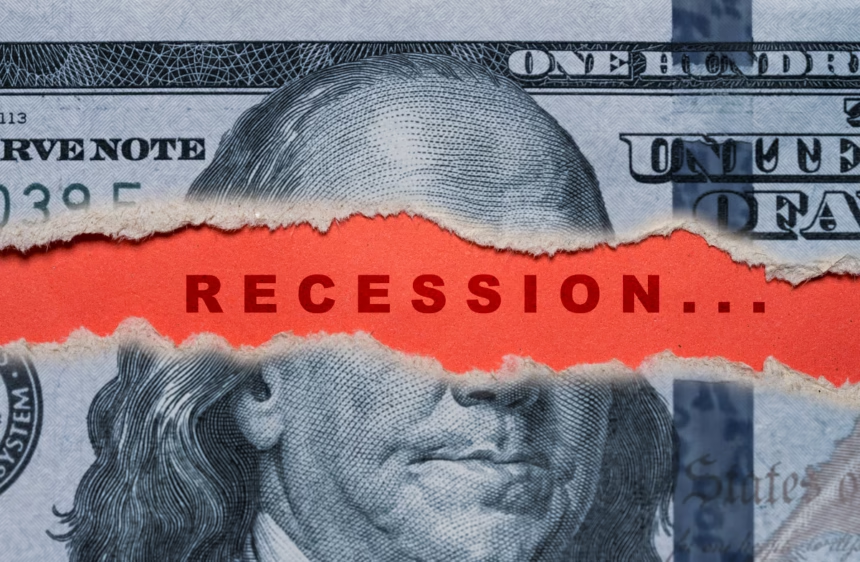
As the cycle deepens, borrowers—once reliable with strong credit scores—begin to default on loans, prompting banks to tighten lending standards and further constricting consumer spending. The report culminates in an economic recession and a stock market crash. Citrini’s authors noted that while they are confident not every scenario will come to fruition, the acceleration of machine intelligence is undeniable, urging investors to reevaluate their market assumptions.
Notably, this speculative piece drew mixed reactions. Michael O’Rourke, chief market strategist at Jonestrading, expressed disbelief that a fictional account could lead to such a tangible market response. Historically, markets have shown resilience in the face of genuine negative news, leading to questions about the validity of investor reactions to fiction.
Analysts are quick to point out that while disruption is a hallmark of technological progress, the extreme scenarios posited by Citrini are unlikely. Historically, economies have adapted to technological shifts, resulting in new job creation and industry evolution. The 1990s internet boom serves as a prime example, where sectors like physical retail and print media saw declines, yet new industries—such as e-commerce and digital services—thrived, ultimately generating numerous job opportunities that had not previously existed.
Technological advancements have been a constant throughout history, from the mechanization of goods in the first industrial revolution to the digital revolution of the last century. Each transition has resulted in economic growth, even amid upheaval, showcasing a trend of eventual adaptation and resilience.
Despite the turbulence in recent years, including the dot-com crash which dramatically eroded market value, the S&P 500 has ultimately seen substantial gains since the mid-1990s, emphasizing that historical trends suggest patience can be rewarded in the stock market. As investors navigate the uncertain waters of an AI-driven future, many might find that the most prudent choice lies in maintaining a long-term perspective.