







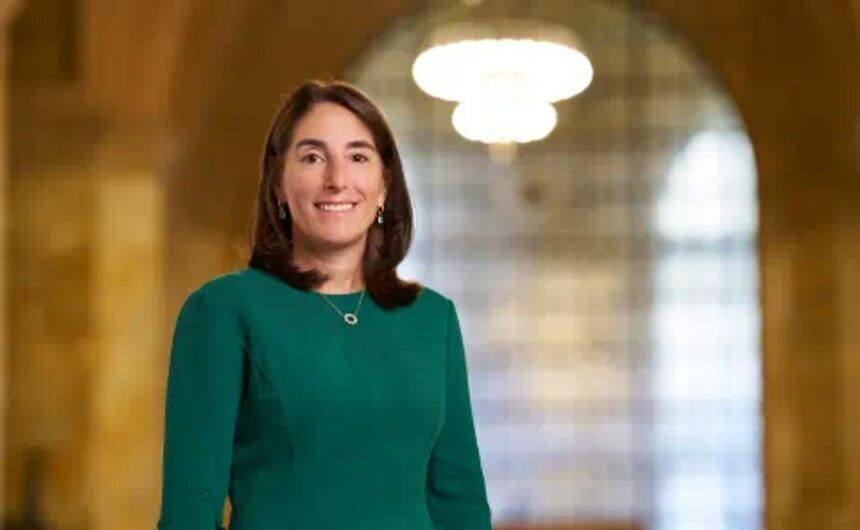
Cleveland Fed President Beth Hammack has emerged as one of the most hawkish members of the U.S. Federal Reserve since her appointment in 2024, following a notable career at Goldman Sachs. With a more prominent role looming on the horizon, she is poised to influence the trajectory of monetary policy significantly.
Next year, Hammack will join the Federal Open Market Committee (FOMC), which is responsible for setting the interest rate policy for the U.S. Among the committee’s twelve voting members are four district Fed presidents who rotate into their voting roles annually. By 2026, Hammack, as head of the Cleveland Fed, will be part of this crucial decision-making body.
In a recent interview with the Wall Street Journal, Hammack articulated her views on interest rates, suggesting that maintaining the current rate policy is a reasonable approach until there is clearer evidence of either inflation returning to target levels or significant weakening in the employment sector. She expressed caution regarding the recent decline in the headline inflation rate from 3.1% to 2.7%, attributing the drop partly to distortions from last year’s government shutdown. Hammack indicated that her calculations suggest a rate closer to 2.9% or 3.0% aligns more with prior economic forecasts.
The implications of central bank policy on risk assets—including stocks, commodities, and cryptocurrencies—typically hinge on whether monetary policy becomes easier. While this year has seen stock markets and commodities like gold and silver reaching historical highs, the cryptocurrency Bitcoin has experienced a downturn, particularly following the Fed’s initial rate cut in September.
A notable divergence in opinions has surfaced within the Fed. Fed Governor Chris Waller, a contender for the next Fed chair, recently characterized the current fed funds rate range of 3.5%-3.75% as being significantly over the neutral rate, suggesting that monetary policy is still restrictive. In stark contrast, Hammack believes that the current fed funds range is “a little bit below” the neutral rate, implying a somewhat stimulative policy stance.
This discrepancy highlights a critical rift between two influential figures who will play a role in shaping policy in 2026. As interest rates evolve over the coming years, the potential for dissent within the typically unified voting process of the FOMC becomes more pronounced. The individual chosen as Fed chair may face challenges in rallying the necessary support for policy decisions, given the differing perspectives among committee members.




