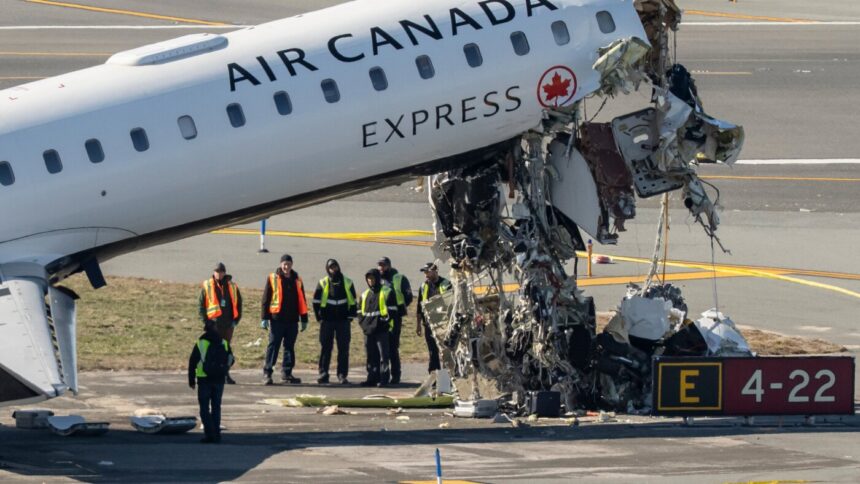
Aircraft maintenance personnel are currently examining the wreckage of an Air Canada Express jet that crashed into a Port Authority fire truck just off the runway at LaGuardia Airport in New York. This tragic incident occurred on a Sunday night, leaving two pilots deceased.
The National Transportation Safety Board (NTSB) has voiced significant concerns regarding staffing procedures in light of the crash. During a Tuesday press conference, NTSB chair Jennifer Homendy revealed that two air traffic controllers were present in the control tower when the incident took place, with at least one controller multitasking across several roles. Stressing systemic issues rather than attributing blame to individuals, Homendy noted, “I would caution pointing fingers at controllers and saying distraction was involved. This is a heavy workload environment.”
Homendy highlighted a frequent practice during the overnight shift at LaGuardia—having two controllers handle duties typically spread across multiple personnel. Given the airport’s high traffic volume, she questioned the appropriateness of this approach. “That’s certainly something we will look at as part of this investigation: Would that make sense? Why would that make sense at LaGuardia?”
At the time of the crash, one controller was designated the local controller, managing current runways and immediate airspace, while the other was in charge of safety operations but was also performing the role of the clearance delivery controller, tasked with granting pilots permission to depart. The NTSB has conflicting information regarding whether the local controller also served as the ground controller, who oversees vehicle movements along taxiways. Homendy acknowledged concerns raised by air traffic control teams regarding staffing for years.
Both controllers were working the overnight shift, a timeframe that the NTSB has previously flagged due to potential fatigue. Although there was no indication that fatigue played a role in this incident, it remains a topic of concern in past investigations.
Transportation Secretary Sean Duffy reported that LaGuardia’s air traffic control staffing level is relatively adequate, with 33 controllers on duty and seven additional trainees. The airport’s goal is to maintain a staffing level of 37 controllers.
The NTSB has recovered the cockpit voice recorder for detailed analysis. NTSB senior aviation accident investigator Doug Brazy provided insights into the final three minutes captured on the recorder. He stated that as the plane approached for landing, the flight crew completed their checklist, alerting air traffic control to their descent. Brazy noted that the transmission from an airport vehicle seeking to cross the runway was inadvertently interrupted by a transmission from the firefighters responding to fumes from a United Airlines plane. Controllers granted the firefighters’ request to cross the runway but instructed them to stop nine seconds before the recording ended. However, Homendy pointed out that the fire truck lacked a transponder, raising concerns about communication during critical moments.
The Airport Surface Detection System, Model X (ASDE-X), which typically tracks surface movements of planes, failed to send an alert in this case. Homendy mentioned that the system could not create a high-confidence track due to the intricate movement of vehicles near the runway. As the cockpit recording neared its conclusion, sounds indicated that the plane landed just eight seconds before the recording ended, with radio communications directing the firefighters to halt.
Despite accumulating substantial information, the NTSB emphasized that initial findings remain preliminary and require thorough verification. Critical questions linger, including the identity of the individual who made the stepped-on radio transmission, the rationale for one of the controllers continuing their duties post-crash, and whether the firefighters received the stop directives. Investigators also have yet to determine if the pilots saw the fire truck or encountered any confusion inside the cockpit. Homendy stated, “We rarely, if ever, investigate a major accident where it was one failure,” underscoring that aviation systems are designed with multiple safety layers to prevent such tragedies.