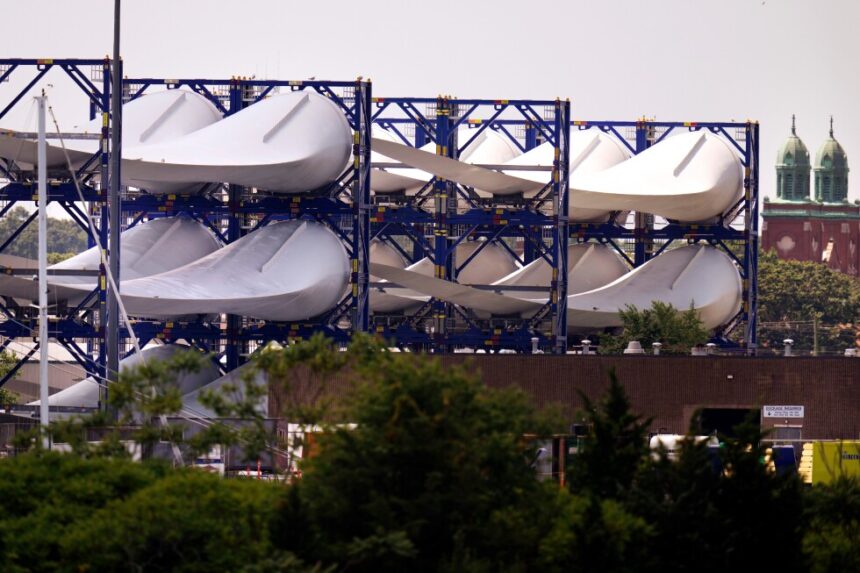
Construction has officially concluded on Vineyard Wind, marking it as a pivotal offshore wind farm project in Massachusetts. This development comes as the first large-scale offshore wind initiative to reach this stage during the Trump administration, despite the former president’s vocal opposition to wind energy.
On Friday night, the installation of the final turbine blades was completed, as confirmed by Craig Gilvarg, a spokesperson for the project. Vineyard Wind faced numerous challenges during its planning and development phases, including a temporary halt imposed by the Trump administration just days before Christmas, which was justified by citing national security concerns. However, legal actions from developers and states led to federal judges permitting the continuation of this project, indicating that the government’s case regarding imminent risk was insufficient.
As Vineyard Wind wraps up its construction, another offshore project called Revolution Wind has begun supplying electricity to New England’s grid, with plans to scale up its output in the upcoming weeks. In contrast, Vineyard Wind has already been providing power for more than a year as it completed additional turbines. The project, a collaboration between Avangrid and Copenhagen Infrastructure Partners, is situated approximately 15 miles south of Martha’s Vineyard and Nantucket and consists of 62 turbines, collectively generating 800 megawatts of clean energy—enough to power around 400,000 homes.
Massachusetts Attorney General Andrea Joy Campbell emphasized the significance of Vineyard Wind’s completion in the context of the state’s energy strategy, which aims to lower costs, meet increasing energy demand, and support climate objectives while preserving thousands of well-paying jobs.
Despite its advancements, Vineyard Wind faced scrutiny due to past incidents such as a blade failure that resulted in fiberglass debris washing ashore on Nantucket beaches during the busy tourist season in July 2024. In response, the turbine’s manufacturer, GE Vernova, agreed to a settlement of $10.5 million to compensate local businesses that suffered losses from the incident.
The project initially submitted its plans to develop an offshore wind farm back in 2017, aligning with Massachusetts’ goal of procuring up to 1,600 megawatts of offshore wind power by 2027. However, federal regulators delayed the project’s progress by withholding a crucial environmental impact statement in 2019—a move criticized by Massachusetts Democratic Representative William Keating, who alleged that the Trump administration was obstructing renewable energy initiatives. It wasn’t until the Biden administration’s approval in 2021 that construction gained momentum.
The inception of the U.S. offshore wind sector began with the opening of the Block Island Wind Farm in Rhode Island in 2016, during Obama’s presidency, but it only featured five turbines and was not regarded as a commercial-scale project. The first significant commercial-scale offshore wind farm came to fruition in March 2024, under Biden’s presidency, marking an evolution in the country’s approach to renewable energy.
Trump’s administration aggressively pursued conventional energy sources, reversing prior policies aimed at fostering the growth of cleaner alternatives. White House spokesperson Taylor Rogers defended this stance, stating that Trump’s strategy focuses on reliable energy sources to improve grid stability and lower energy bills while preserving national security, characterizing Biden’s approach as overly reliant on intermittent energy sources.
The future of offshore wind in the U.S. appears to be set on a path of growth and expansion, with projects like Vineyard Wind leading the charge amid the complexities of political, environmental, and economic factors.