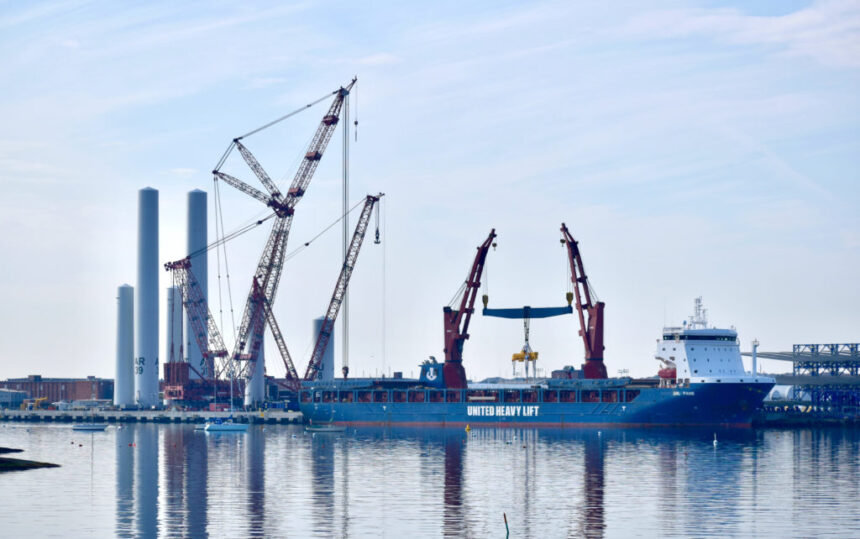
Construction has officially concluded on a significant offshore wind farm in Massachusetts, marking a pivotal moment in the nation’s renewable energy landscape. Vineyard Wind, the first offshore wind project to reach this stage during the Trump administration, completed its construction late Friday night, with the final turbine blades successfully installed, according to project spokesperson Craig Gilvarg.
This development comes against a backdrop of the Trump administration’s critical stance on wind energy. President Trump has frequently expressed his disdain for wind power, asserting a determination to prevent the construction of “windmills.” In a dramatic turn of events, Vineyard Wind was one of five major offshore wind projects that faced a last-minute halt from the Trump administration days prior to Christmas, with officials citing national security risks. Prompted by legal action from developers and various states, federal judges overrulled the government’s decision, allowing construction to resume and highlighting that national security concerns had not been substantiated to the extent of warranting a project halt.
In a related development, Revolution Wind, another of the five halted projects, began supplying power to New England’s electric grid on the same Friday Vineyard Wind finished construction. As it continues to ramp up operations in the forthcoming weeks, Revolution Wind’s entry adds to the region’s renewable energy resources.
While Revolution Wind is just beginning its journey to full operational capacity, Vineyard Wind has been providing electricity for over a year as more of its 62 turbines came online. The joint venture between Avangrid and Copenhagen Infrastructure Partners is positioned 15 miles south of Martha’s Vineyard and Nantucket, boasting a total generation capacity of 800 megawatts—enough clean energy to power approximately 400,000 homes.
Massachusetts Attorney General Andrea Joy Campbell underscored the significance of Vineyard Wind’s completion, stating that the project is crucial for the state to reduce energy costs, meet growing demand, fulfill climate targets, and support thousands of well-paying jobs.
However, Vineyard Wind has not been without its challenges. The Trump administration particularly scrutinized the project following an incident in July 2024 when a blade failure led to fiberglass fragments washing ashore on Nantucket beaches during peak tourist season. In response, manufacturer GE Vernova reached a settlement of $10.5 million to compensate affected island businesses.
The journey for Vineyard Wind began in 2017 when it submitted its plans for the offshore wind farm, aligning with Massachusetts’ commitment to offshore wind energy. The state mandated utilities to seek proposals for up to 1,600 megawatts of offshore power by 2027. Yet, the project faced severe delays, especially due to federal regulators postponing a critical environmental impact statement in 2019. At that time, Democratic Representative William Keating voiced concerns that the Trump administration was intentionally obstructing a pivotal renewable energy project.
The tide began to shift when the Biden administration endorsed the project in 2021, signaling a renewed commitment to offshore wind energy as a strategic component in combating climate change. Construction got underway in Barnstable, Massachusetts following this endorsement.
Vineyard Wind’s completion signifies a milestone in the U.S. renewable energy sector, particularly following the establishment of the country’s first commercial-scale offshore wind farm in March 2024, constructed by Danish developer Orsted and utility Eversource off Montauk Point, New York.
Throughout his term, Trump pursued a rollback of the country’s renewable energy policies, prioritizing oil, gas, and coal through a series of executive orders. In response to the successful completion of Vineyard Wind, White House spokesperson Taylor Rogers reiterated Trump’s commitment to counter the Biden administration’s approach, asserting that his administration is focused on promoting reliable energy resources to stabilize energy prices and enhance grid security.