American consumers are poised to experience financial strain as the ongoing conflict in Iran reshapes global economic dynamics, despite a surprisingly resilient performance from the stock market and the U.S. dollar. Derek Horstmeyer, a finance professor at George Mason University’s Costello College of Business, pointed out the incongruity between the military engagement’s implications for oil supply and the minimal impact on the S&P 500 index.
Horstmeyer emphasized that while the conflict has led to the potential closure of the strategically vital Strait of Hormuz—responsible for 20% of the world’s oil supply—resulting in crude oil prices soaring above $100 per barrel, the S&P 500 has only seen a slight decrease of approximately 2% over the past month. He attributes this resilience to a significant shift in market composition; today’s benchmark index is less dependent on oil than in previous decades. This contrasts sharply with the past, where giants such as General Electric and Exxon Mobil wielded more influence.
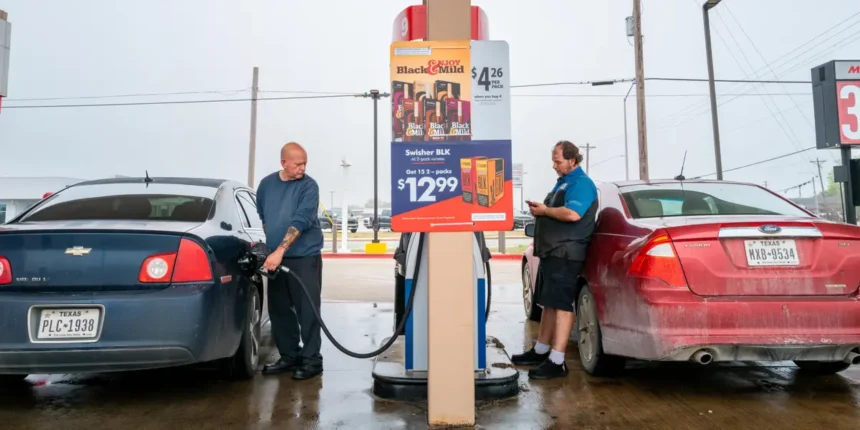
However, consumers are in a different situation. Horstmeyer stated that the negative consequences of elevated oil prices would be felt directly in their wallets. Even if the military conflict sees a swift resolution, he predicts that the oil supply chain recovery could take weeks. Consequently, gasoline prices are expected to linger between $3 and $4 per gallon for at least the next month.
Looking ahead, Horstmeyer warned that while stock markets might eventually face corrections of 10% to 20%, consumers would suffer from higher energy prices that contribute to inflation. He reflected on the paradox where the United States, while instigating global turmoil, simultaneously benefits from an influx of investment into the dollar—widely recognized as the world’s reserve currency.
Horstmeyer forecasted that the U.S. dollar index would likely remain around 100 points until the end of the conflict, with gold prices expected to maintain levels above $5,000 per ounce, reinforcing its status as a safe haven asset in times of uncertainty.
In parallel, changes in the technological landscape are unfolding, particularly in the burgeoning area of artificial intelligence (AI). Insights from Horstmeyer reveal a nuanced perspective on the AI sector, influenced by Anthropic’s recent advancements with its AI model, Claude. He views the potential for multiple companies to establish themselves within distinct market niches rather than all companies converging on a few generic large language models.
Horstmeyer compared the current AI infrastructure growth to historical technological booms such as those seen with fiber optics and railroads. He suggested that even if some tech companies overestimate demand and overinvest in resources like microchips and data centers, the capacity created could benefit future developments.
At the same time, caution remains as historic bubbles in technology have often preceded market downturns. Horstmeyer echoed sentiments shared by notable investors who have expressed skepticism about AI’s long-term stability, with most companies from past tech bubbles failing to survive. He noted the importance of a cautious approach, advocating for a strategy that involves monitoring the market without making drastic moves.
Overall, as the dual pressures of geopolitical conflict and rapid technological advancement resonate across markets, consumers and investors alike are left to navigate an uncertain economic landscape.