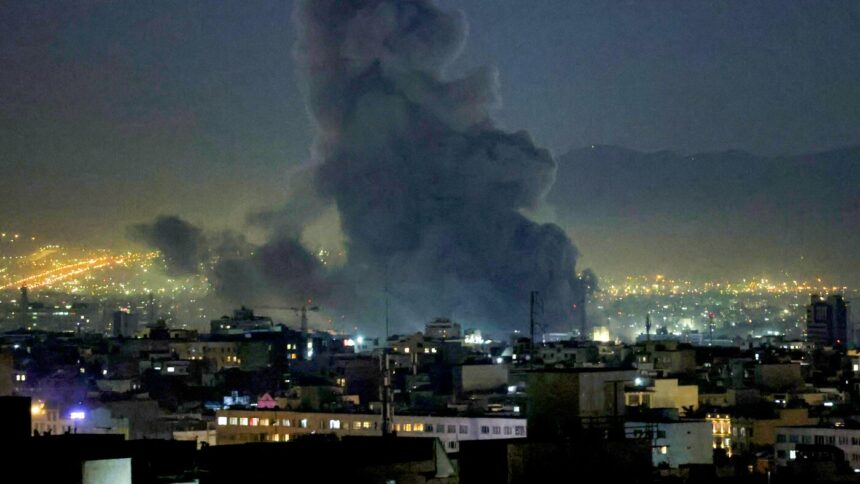
Smoke billowed in Tehran following a series of missile strikes on March 1, 2026, attributed to coordinated actions by the United States and Israel. These military operations, which commenced on February 28, resulted in the death of Iran’s supreme leader, Ayatollah Ali Khamenei, along with several high-ranking military officials. In a swift response, Iranian authorities launched retaliatory strikes against both Israeli targets and U.S. bases in the Gulf, escalating tensions in the region.
As the dust settled from these strikes, attention turned to the financial ramifications of the events unfolding in Iran, particularly regarding the prediction market known as Polymarket. An anonymous trader, known by the handle “Magamyman,” reportedly profited more than $553,000 by betting that Khamenei would be out of power just moments before his death was confirmed. This revelation has sparked significant scrutiny from members of Congress and critics who argue that such prediction markets allow individuals with access to insider information to profit from lethal military actions.
Senator Chris Murphy (D-Conn.) voiced his disapproval on social media, stating, “It’s insane this is legal,” while indicating plans to introduce legislation aimed at banning such activities. Murphy criticized the practice, suggesting that those within former President Trump’s circles might be exploiting tragic events for financial gain.
Despite these claims, the White House denied any involvement from Trump’s associates in the recent trading activity. Nevertheless, connections between the Trump family and Polymarket have raised eyebrows. Donald Trump Jr. serves as an advisor to Polymarket, and his venture capital firm, 1789 Capital, has reportedly invested millions in the platform. Additionally, previous federal investigations into Polymarket were reportedly halted under the Trump administration, further complicating the narrative.
This incident is not an isolated one; it adds to an ongoing controversy regarding the monetization of classified information through prediction markets. For example, earlier this year, a trader made significant profits by placing bets shortly before Venezuelan leader Nicolás Maduro’s arrest, showcasing the potential for insider trading on such platforms. In a separate case, authorities in Israel charged two individuals for utilizing classified information to place bets regarding military actions against Iran during a short-lived conflict in June.
The recent surge in trades concerning the overthrown Iranian leadership occurred on Polymarket’s overseas exchange, placing it beyond the reach of U.S. regulatory oversight. While the Trump administration has signaled intention to launch a U.S.-based version of Polymarket, many users continue accessing its current offerings through virtual private networks that disguise their identities.
Federal oversight of prediction markets is complex, with the Commodity Futures Trading Commission recognizing them as “futures contracts” rather than gambling, despite existing laws that forbid trades based on death and violence. This regulatory ambiguity was highlighted when another prediction market, Kalshi, faced its own controversy. Following Khamenei’s death, Kalshi paused trading on related markets and indicated it would issue refunds to users who placed bets, citing the potential for conflict with U.S. laws prohibiting profit derived from death-related bets.
Kalshi’s decision has stirred discontent among traders, some of whom accused the platform of misleading them after it promoted the Khamenei market heavily prior to his death. Frustrated users expressed their outrage on social media, condemning what appeared to be arbitrary adherence to regulatory compliance at the expense of traders’ expectations.
Experts, including Amanda Fischer, a former Securities and Exchange Commission official, have called for congressional action to curtail the influence of prediction markets that incentivize wagering on violent events. Fischer emphasized the necessity of addressing the “perverse incentives” created by betting on conflict, war, and assassination, denouncing the confusion surrounding such markets as grounds to eliminate them altogether.
As tensions escalate and the consequences of military actions ripple through multiple sectors, the intersection of warfare, financial speculation, and ethical accountability remains a contentious issue requiring urgent attention.