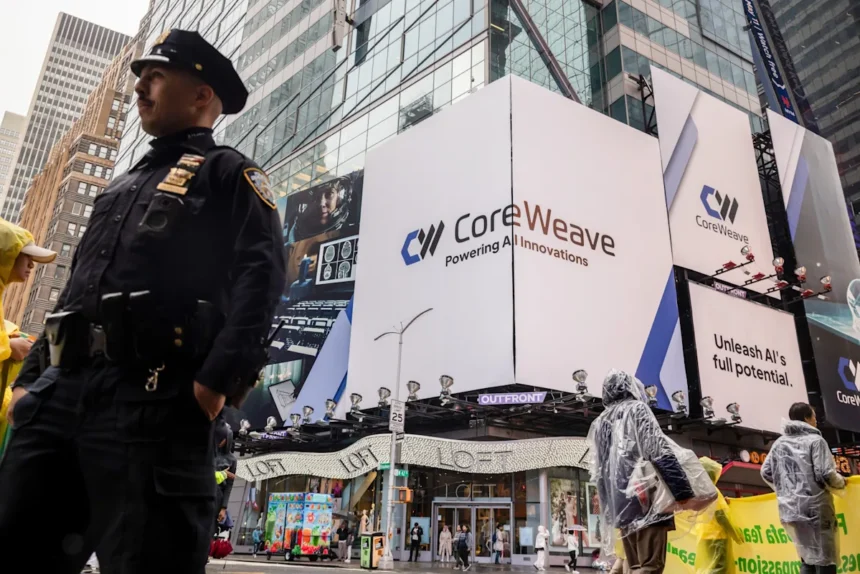
Shares of CoreWeave Inc. experienced a significant decline following the company’s announcement of a lowered annual revenue forecast, attributed to delays in fulfilling a customer contract. This setback comes amid the heightened demand for artificial intelligence services, which the company has been striving to capitalize on.
During a recent conference call, CoreWeave updated its forecast projections for 2025, indicating expected sales between $5.05 billion and $5.15 billion, a reduction from an earlier estimate that reached as high as $5.35 billion. CEO Michael Intrator cited “temporary delays” as a key factor affecting the company’s performance, specifically pointing to issues with a third-party data center developer struggling to meet timelines. Despite these delays impacting fourth-quarter results, the client involved has agreed to adjust delivery schedules, ensuring the total contract value remains intact.
This development highlights the significant challenges CoreWeave faces as it attempts to align with the soaring interest in AI technologies. Following the announcement, CoreWeave shares plummeted by 13%, marking the largest intraday decline in three months, and landing at $92.03. Prior to the announcement, the company’s stock had already seen a remarkable increase of over 100% this year.
Since its IPO in March, CoreWeave has drawn considerable attention from investors eager to engage with the burgeoning AI sector. The Livingston, New Jersey-based company partners closely with AI chip manufacturer Nvidia and boasts a growing clientele that includes OpenAI and Microsoft.
As part of the neocloud sector, CoreWeave provides access to high-performance AI chips, with surging demand prompting rapid expansions of its data centers and a push to equip them with cutting-edge technology. Additionally, the company is actively working to diversify its customer base, which has traditionally been heavily reliant on Microsoft.
In an interview, Intrator acknowledged the persistent delays encountered in scaling AI computing capabilities and expressed the frustrations shared by all parties involved—CoreWeave, the data center provider, and the client waiting for services. He emphasized the importance of being proactive on-site to address any arising issues promptly, stating, “We’re doing all the right things. It’s just a challenging environment.”
Intrator underscored a commitment to strengthening partnerships and diversifying supplier options to mitigate future disruptions, reassuring stakeholders that the current issues would be resolved swiftly. He expressed a desire for government support in expediting permitting processes and enhancing infrastructure connectivity to power grids, which is vital for the AI data center market.
In its third-quarter results, CoreWeave reported an operating income margin of 4%, which fell short of the anticipated 6.5% and was lower than the same quarter last year. However, revenue reached $1.36 billion, surpassing analyst projections of $1.29 billion. The company posted a loss of 22 cents per share, a notable improvement compared to the 57-cent loss forecasted by Wall Street.
At the end of the quarter, CoreWeave’s revenue backlog—a measure of projected future sales—stood at an impressive $55.6 billion, nearly double the previous period’s figures. In a recent move to secure its growth, CoreWeave announced a substantial agreement to provide up to $14.2 billion in computing power to Meta Platforms Inc., the parent company of Facebook and Instagram. However, with Microsoft contributing 71% of revenue in the prior quarter, the company has expressed the urgency to stabilize its customer mix.
Additionally, CoreWeave’s bid to acquire Core Scientific Inc. was turned down by shareholders last month over concerns about undervaluation. The company opted to proceed without this acquisition, announcing an alternate, smaller deal shortly thereafter. This decision reflects CoreWeave’s strategic approach to navigating the fast-evolving landscape of AI infrastructure and technology.