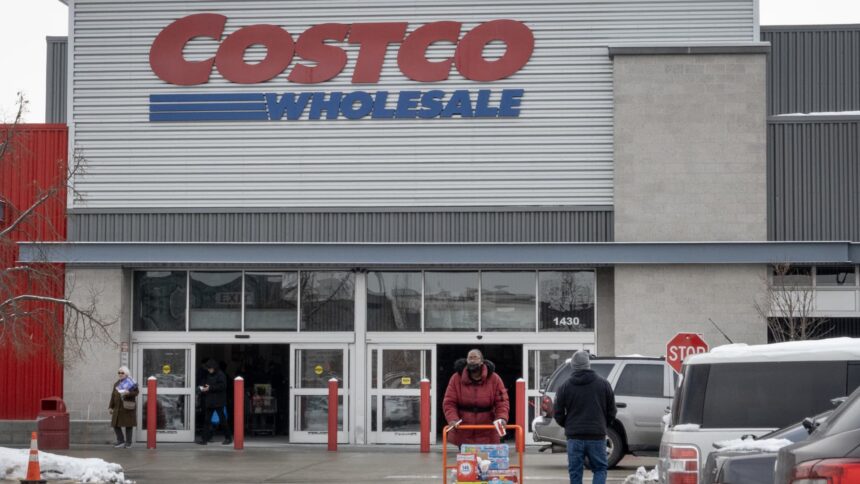
Customers flocked to Costco stores nationwide, particularly in Chicago, where shoppers filled the parking lot outside the warehouse club on December 2, 2025. On Thursday, Costco reported its fiscal first quarter performance, exceeding Wall Street’s expectations amid a competitive market landscape. The retailer experienced an impressive 8.2% increase in sales compared to the same period last year, garnering attention for its robust financial health.
Despite not providing a full-year outlook, Costco is set to discuss further details during an earnings call slated for 5 p.m. ET. Analysts had anticipated strong results, and the figures came in positively. The company announced earnings per share of $4.50, surpassing the expected $4.27. Revenue for the quarter hit $67.31 billion, also exceeding the projected $67.14 billion.
Costco’s ability to attract new members and witness heightened sales both in-store and online has been pivotal in its growth. As inflationary pressures lead consumers across various income levels to seek value, the retailer has seen a surge in demand for groceries, household essentials, and holiday gifts. Particularly notable is Costco’s success in appealing to younger demographics, who are increasingly signing up for memberships.
A contributing factor to the recent financial success was the membership fee increase implemented in the U.S. and Canada that took effect in September 2024. This change became advantageous as new members joined or existing customers renewed their annual memberships.
For the three-month period ending November 23, Costco reported a net income of $2 billion, or $4.50 per share, a notable rise from $1.80 billion, or $4.04 per share, in the same quarter last year. Additionally, revenue climbed from $62.15 billion in the prior year to the current $67.31 billion. Comparable sales, a key performance indicator that excludes the effects of one-time factors such as store openings, rose 5.9% in the U.S. and 6.4% globally, with digital sales soaring by 20.5% year over year.
Operating as a warehouse club, Costco’s revenue model heavily relies on membership fees, which contribute significantly to keeping prices low. However, rising tariffs have posed challenges to its cost structure, particularly since approximately a third of Costco’s U.S. sales stem from imported goods. In response, the company has been proactive, suggesting alternative items via its private-label brand, Kirkland Signature, to mitigate the financial impact of tariffs.
In recent developments, Costco has taken legal action against the Trump administration, seeking refunds for new tariffs incurred this year and requesting that further import duties be blocked while awaiting a Supreme Court ruling.
Despite a nearly 4% decline in stock price this year, which contrasts with the S&P 500’s 17% gains, the long-term outlook appears strong; Costco’s stock has surged by 141% over the past five years. The stock closed at $884.48 on Thursday, assigning a market value of $392.67 billion to the retail giant. This ongoing narrative encapsulates Costco’s resilience and adaptability in the ever-evolving retail market.