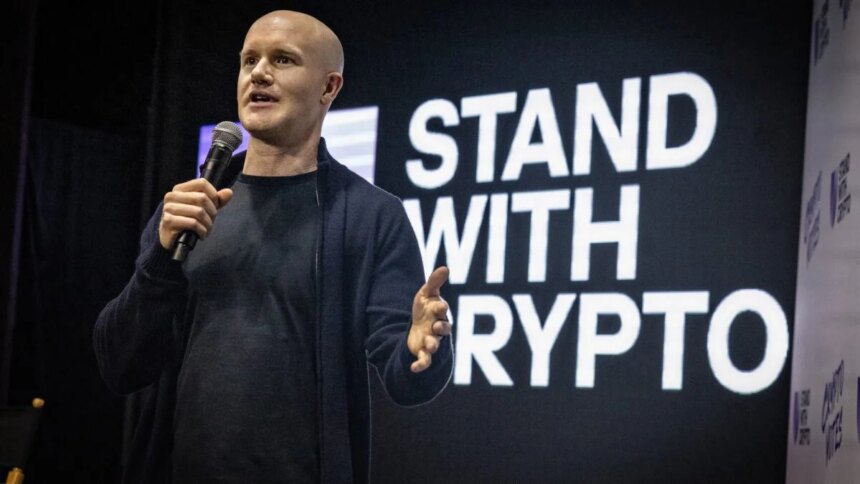
At the 2026 World Economic Forum in Davos, Switzerland, discussions have increasingly focused on the tension between the cryptocurrency industry and traditional banking institutions. This comes in light of ongoing lobbying efforts regarding the CLARITY Act, a pending bill in the U.S. Senate aimed at clarifying the regulatory framework for the crypto market.
During a CNBC interview, Brian Armstrong, CEO of Coinbase, expressed his commitment to advocating for a more favorable regulatory environment for cryptocurrency users. He accused banking lobbyists of trying to stifle competition by limiting the growth of crypto companies like Coinbase. “Their lobbying arms and their trade groups are coming in and trying to ban their competition,” Armstrong stated, emphasizing that healthy market competition should not be curtailed.
Despite these tensions, Armstrong revealed that Coinbase collaborates with five of the world’s top 20 banks to provide essential crypto infrastructure services, suggesting that the commercial sector of these banks perceives opportunity in the evolving financial landscape.
Last week, Coinbase withdrew its support for the CLARITY Act after legal concerns regarding a draft version of the bill. Shortly thereafter, the Senate Banking Committee postponed the bill’s markup. Armstrong articulated the position of Coinbase by stating on social media, “We’d rather have no bill than a bad bill. Hopefully, we can all get to a better draft.”
The CLARITY Act aims to resolve ambiguities in the regulatory framework governing various crypto assets, distinguishing between commodities and traditional securities, thereby allowing the Commodity Futures Trading Commission (CFTC) and the Securities and Exchange Commission (SEC) to tackle their respective regulatory concerns independently. The bill also addresses protections for non-custodial developers—those who write code but do not operate financial services—an issue that has gained prominence in the wake of punitive actions against developers linked to privacy-focused platforms.
Historically, the crypto industry sought regulatory clarity during the Biden administration but faced challenges under SEC Chair Gary Gensler. Gensler’s stance was that the regulatory framework was adequate, albeit unwelcomed by the crypto sector, which largely viewed assets beyond Bitcoin as unregistered securities. This led to numerous enforcement actions, although many cases have been resolved since the new administration took charge.
As crypto moves toward a more centralized model, its competition with traditional banking structures intensifies. Notably, UBS CEO Sergio Ermotti acknowledged blockchain as a potential future cornerstone for traditional banking, hinting at an inevitable convergence between the two sectors.
Banking lobbyists have expressed concern over certain provisions in the CLARITY Act that could disrupt their business models, particularly surrounding stablecoins and tokenized assets. As stablecoins gain traction, banks fear losing customers to them due to potentially higher interest rates. Although recent legislation, the GENIUS Act, aimed to curtail interest payments from stablecoin reserves, it did not explicitly prevent affiliates like Coinbase from offering interest through partnerships with stablecoin issuers.
The growing influence of the crypto lobby, which reportedly disbursed $133 million to pro-crypto candidates during the 2024 election cycle, has positioned it as a formidable player in the political arena. Coinbase has been at the forefront of these lobbying efforts, contributing around $50 million to relevant political action committees.
Uncertainties remain regarding the passage of the CLARITY Act, with prediction markets currently estimating only a 40% chance of its approval, a sharp decline from an 80% estimate shortly prior. Speaking at the Davos forum, President Trump mentioned ongoing legislative efforts, stating, “Congress is working very hard on crypto market structure legislation—bitcoin, all of them—which I hope to sign very soon.”
The outcome of these discussions could significantly impact the future dynamics between cryptocurrency and traditional financial institutions, shaping the regulatory landscape and the level of competition within the financial sector.