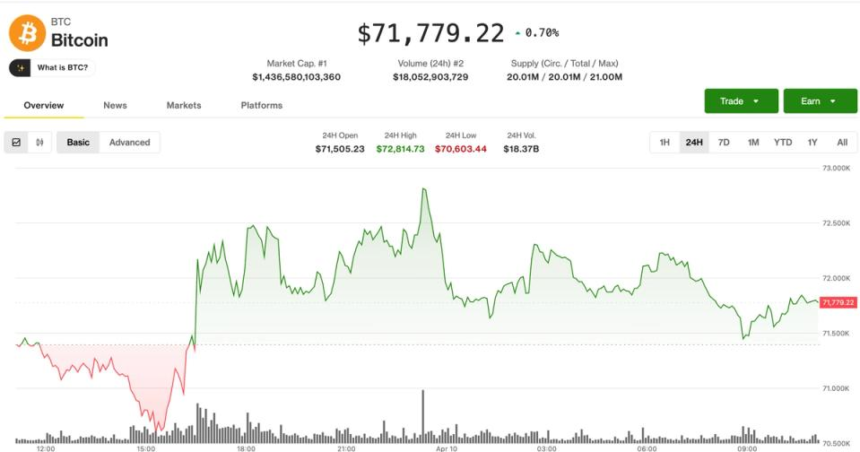
The cryptocurrency market observed a period of stability on Friday, with Bitcoin trading at approximately $71,700 and Ether at $2,180. This behavior aligns with the low-volatility trend that has characterized the market over the last several months. Notably, Bitcoin’s price has remained within a tight range of $63,000 to $75,000 since early February, a pattern that, according to crypto analyst Eric Crown, typically precedes significant price movements. In previous cases of such narrow trading, Bitcoin has seen fluctuations of up to 40%.
A breakout beyond the $75,000 mark could instigate upward momentum by forcing short-position traders to cover their bets at market prices. Conversely, a dip below $70,000 might trigger liquidations of around $200 million in long positions that are positioned for a breakout, according to CoinGlass’ liquidation heatmap.
A crucial factor influencing the market on Friday is the upcoming U.S. consumer price index (CPI) data, which is anticipated to reflect a year-on-year inflation rate of 3.3% for March, largely fueled by rising energy costs. Such inflation figures typically strengthen the U.S. dollar, potentially applying downward pressure on riskier assets, including Bitcoin.
In the derivatives market, open interest in Bitcoin futures rose by 1%, while average perpetual funding rates across major exchanges reached their highest level since February 4. This uptick indicates a growing investor interest in bullish strategies. In addition to Bitcoin, open interest slightly increased for XRP, while remaining stable for Ether and Solana. Other cryptocurrencies, such as HYPE and AVAX, exhibited a positive combination of growth in open interest and favorable funding rates. Conversely, the privacy-focused ZEC showed open interest growth alongside negative funding rates, suggesting that traders are hedging against potential downside risks even amid rising spot prices.
Despite these developments, Bitcoin’s 30-day implied volatility index continues to trend downward, currently at 45%—a marked decrease from the 58% observed on March 31. A similar pattern is noted for Ether’s volatility index. This decline in volatility is largely attributed to activity related to exchange-traded funds (ETFs), creating a feedback loop where institutions selling call options for yield suppress volatility, which in turn makes the sale of additional calls more appealing. Maxime Seiler, CEO of STS Digital, explained that Bitcoin’s options market is evolving toward a structure that resembles traditional equities.
In terms of performance metrics, the implied volatility term structure appears flattened for the next six months, suggesting that the market anticipates a period of relative calm, followed by a rise in volatility as September approaches. On Deribit, Bitcoin and Ether options continue to show a preference for put options, although this bias has weakened recently as sentiment shifts towards bullish strategies, particularly evident in Bitcoin call options at the $80,000 strike.
When looking at specific tokens, the CoinDesk’s DeFi Select Index (DFX) emerged as the strongest performer on Friday, gaining 0.38%, while the CoinDesk 5 (CD5), which is Bitcoin-focused, saw a slight decline of 0.25%. Meanwhile, the CoinDesk Computing Select Index (CPUS) experienced the largest drop, losing 1.4%, negatively impacted by Bittensor (TAO), which saw its value plummet over 12%. The decline follows an announcement from Covenant AI, one of its largest subnet developers, stating its decision to exit Bittensor.
Covenant AI’s founder, Sam Dare, voiced his frustration regarding the foundational promise of decentralization in the project, labeling it a falsehood. In contrast, DASH stood out from the prevailing market trend, surging more than 19% since midnight UTC and achieving a 24-hour gain of 34% as traders showed renewed interest in the privacy sector.