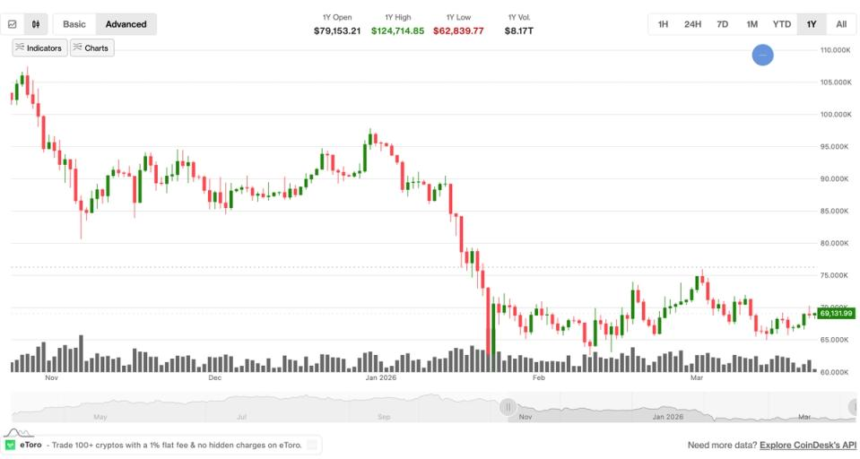
The cryptocurrency market is experiencing sluggish trading within a well-defined range that has persisted for the past two months. Bitcoin is currently trading at approximately $67,856.41, with recent fluctuations bringing it around the $69,000 mark, while ether (ETH) is being exchanged at around $2,130. This trading range has been in place since February 6, characterized by several peaks between $72,000 and $75,000 and troughs around $62,000 to $65,000. Analysts are drawing parallels between this period and a previous similar cycle that occurred between November and January, which eventually led to a significant price breakdown. This historical pattern raises concerns that the current situation could unfold in the same manner.
A critical factor influencing the market is the ongoing conflict in Iran, compounded by U.S. President Donald Trump’s strong rhetoric signaling potential military action. However, his threats have thus far failed to shift the market significantly. Meanwhile, Brent crude oil prices are hovering around $107 per barrel, which may contribute to ongoing inflationary pressures throughout the year unless a downward trend in oil prices emerges.
In terms of market dynamics, bitcoin’s open interest (OI) has stabilized at $16.7 billion, indicating that speculative activity remains largely stagnant. Funding rates have settled into a neutral 0%-6% range, following a previous period of negative funding that was linked to the initial relief rally driven by short covering. Additionally, the three-month annualized basis remains largely unchanged, reflecting a cautious attitude among institutional investors. This suggests that while immediate downside risks appear to have diminished, key players are waiting for more concrete indicators before committing to positions that would signal a major breakout.
Options sentiment is also stabilizing, with call options now dominating 47% of the market. The one-week skew has decreased to 16% from 19% the previous week, indicating slight shifts in market sentiment. However, the front-end backwardation in the implied volatility term structure suggests that traders remain focused on immediate downside protection rather than long-term growth expectations.
Recent data from CoinGlass reveals a total of $163 million in 24-hour liquidations, split 60-40 between long and short positions, with bitcoin leading at $64 million, followed by ether at $35 million, and various other tokens accounting for $16 million. The liquidation heatmap from Binance highlights the $69,500 level as crucial to watch for any potential upward price movement.
On a more positive note, the altcoin market has shown unexpected resilience amidst the broader market’s inertia. Privacy tokens such as zcash (ZEC) and dash (DASH) have risen by 6.7% and 3.1%, respectively, since midnight UTC. Other tokens like FET, PUMP, and RENDER have also demonstrated notable gains. The bitcoin-focused CoinDesk 20 (CD20) index increased by 0.3% on Tuesday but was outstripped by the CoinDesk Memecoin Index (CDMEME) and CoinDesk Computing Select Index (CPUS), highlighting the relative strength of altcoins as compared to major cryptocurrencies.
However, the resurgence of altcoins has not been uniform across the board. While various segments, particularly AI and privacy tokens, have performed well, some tokens have seen significant losses. Over the past 90 days, ethena (ENA) has dropped by 66%, with TIA, LDO, SUI, and ARB experiencing falls of over 50%. This divergence suggests a maturation of the market where assets may start to respond to real-world implications rather than following the previous trend of collecting hype and ambitious roadmaps.