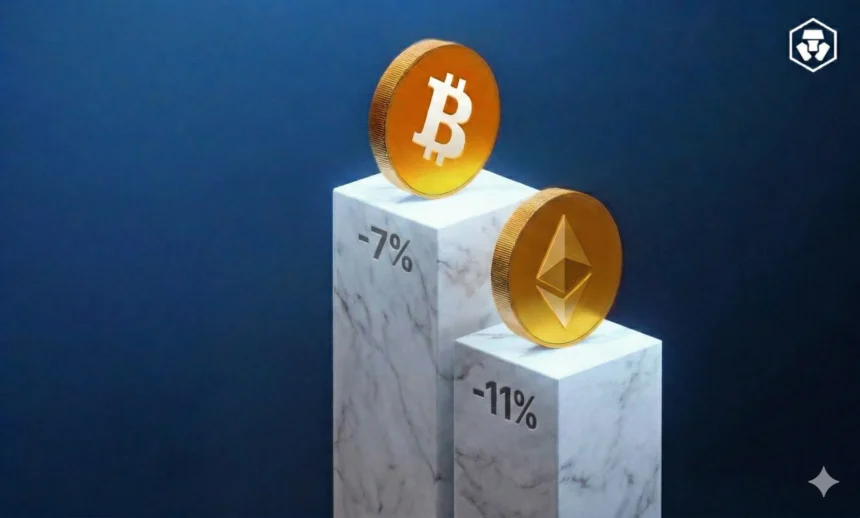
In recent years, the cryptocurrency market has emerged as a rapid barometer of investor sentiment during geopolitical conflicts, responding more swiftly than traditional financial markets. Digital asset exchanges operate continuously and, as such, are primed to react immediately to breaking news, particularly when significant events occur over weekends or outside standard trading hours.
Historical data illustrates the crypto market’s tendency for sharp, short-term volatility in the wake of international tensions. Often, investors engage in a ‘de-risking’ strategy, selling liquid assets like Bitcoin (BTC) or Ethereum (ETH) to shift into cash or commodities such as gold until further clarity on geopolitical developments can be gleaned.
Several case studies from recent years offer insight into how the market reacts to global conflicts.
In February 2022, when Russia invaded Ukraine, Bitcoin’s value dropped dramatically from about $39,000 to $34,322 within hours. This decline, classified as a ‘risk-off’ response, was fleeting. By early March, Bitcoin had risen back to $44,000, fueled by a conversation shift that framed Bitcoin as a tool for financial sovereignty. This narrative gained traction as both Ukrainian refugees and individuals facing sanctions sought decentralized assets for cross-border transactions.
In October 2023, when conflict escalated between Israel and Hamas, Bitcoin initially fell to $27,000. However, unlike the previous year’s reaction, the market stabilized without prolonged losses. Investors soon redirected their attention to the anticipated approvals of spot exchange-traded funds (ETFs) in the United States. By the end of the month, Bitcoin had nearly reached $35,000, marking a notable shift in market dynamics where industry developments began to eclipse geopolitical headlines.
Looking ahead to 2025 and 2026, the consequences of trade conflicts were notably different. In April 2025, U.S. tariffs announced by President Donald Trump triggered a significant ‘risk-off’ phase in the global economy. Bitcoin experienced a sharp decline, dropping over 10% to below $78,000, while Ethereum encountered its most significant three-day loss since late 2022, declining by 25%. This situation taught traders an important lesson — global trade barriers, rather than localized military actions, can have a more direct effect on cryptocurrency liquidity.
In February 2026, a new military campaign, dubbed ‘Operation Epic Fury’, led to Bitcoin’s value dropping from $68,000 to roughly $63,000 but rebounding to above $67,000 by March 1. Trump’s announcement regarding the military operation’s anticipated duration seemed to provide the market with a clearer timeline, allowing traders to factor in a ‘war premium’ as the conflict unfolded.
Throughout these tumultuous periods, Bitcoin has struggled with its identity as a ‘digital gold’. While it has historically faced liquidity issues at the onset of conflicts, recovery times have notably shortened. As institutional adoption through ETFs increases, Bitcoin finds itself caught between being viewed as a high-growth risk asset and a decentralized store of value.
During the opening of traditional markets following the announcement of military actions in 2026, the contrast between ‘physical safety’ and ‘digital risk’ became apparent. Gold surged over $100 per ounce to reach its highest level in over a month, reaffirming its status as the primary safe-haven asset. Meanwhile, Bitcoin encountered challenges maintaining its momentum, even as its own value briefly rebounded.
In a significant shift, the correlation between Bitcoin and gold turned negative in 2026, while its relationship with the Nasdaq index surged, indicating that institutional risk models increasingly categorize Bitcoin as ‘commodified risk.’ Consequently, during periods of unrest, traders have tended to sell Bitcoin to cover margin calls in equities while opting for gold to mitigate fiat currency risks.
For Bitcoin to reestablish its ‘digital gold’ narrative, it must demonstrate the ability to decouple from the Nasdaq during military escalations — a challenge it has yet to overcome in the current conflict cycle.
This evolving landscape reveals the complex interplay between cryptocurrency, global conflict, and investor behavior, suggesting that further developments in geopolitical dynamics will continue to shape the volatile fortunes of digital assets.