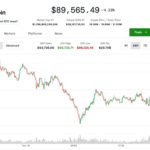
The cryptocurrency markets are facing significant pressure today, with Bitcoin’s price lingering near a seven-month low and notable declines observed in leading crypto-related stocks.
Currently, Bitcoin is trading at approximately $89,090, representing a 4% drop over the last 24 hours. This decline comes alongside a substantial trading volume of $71 billion within that same timeframe. Bitcoin was recently 4% below a seven-day high of $93,662 and has remained nearly steady from a seven-day low of $88,800, according to data from Bitcoin Magazine Pro. With a total circulating supply of 19.95 million BTC out of a capped 21 million, Bitcoin’s market capitalization is reported at $1.78 trillion.
The decline is echoed in the performance of significant crypto stocks, with Coinbase Global decreasing by 4.9%, Bitfarms dropping 7.5%, Strategy falling by 10.3%, Riot Platforms losing 3.7%, Hut 8 Mining down 3.3%, and Mara Holdings slipping by 6.6%.
Market movements have been notably affected by investor activity in Bitcoin exchange-traded funds (ETFs). BlackRock’s spot Bitcoin ETF, IBIT, recently experienced a record single-day outflow of $523.2 million on Tuesday, highlighting an unprecedented withdrawal since its inception in January 2024. This outflow occurred despite a brief price uptick of 1% for Bitcoin earlier in the week, which briefly lifted the cryptocurrency above the $93,000 mark.
Investors in IBIT have an average purchase price of $90,146 for Bitcoin, putting them at a loss in the current market.
Market analysts suggest that while immediate price fluctuations are predominantly sentiment-driven, underlying long-term trends are dictated by broader macroeconomic positioning and liquidity dynamics. Current sentiment indicators appear to be at multi-year lows, indicating weakened trading activity but also potentially presenting favorable entry points for long-term investors.
In response to ongoing market volatility, Bitcoin miners seem to be adapting their strategies. After a phase of heavy sales, their 30-day net BTC position has shown a shift to modest accumulation, attributed to recent capital raises within the sector. This trend suggests a revived confidence among miners in retaining their mined Bitcoin rather than liquidating it.
Despite the challenges posed by fluctuating ETFs and market prices, observers note that Bitcoin’s core fundamentals remain robust. Trends in liquidity and sustained institutional interest indicate that Bitcoin may achieve stability around the $90,000 mark as investors navigate an unpredictable environment.
However, market sentiment is still quite pessimistic, particularly after Bitcoin breached the crucial $96,000 weekly support level last week. Analysts from Bitcoin Magazine Pro and Feral Feral Analysis caution against expecting a significant rebound, highlighting strong resistance levels above $94,000 and continued selling pressure. They point to significant support zones around $83,000–$84,000 and a more substantial support range between $69,000–$72,000, suggesting a further decline into the mid-$80,000 range is increasingly likely amid rising volatility.
Upside scenarios are currently limited; even a potential short squeeze would face robust resistance at the $106,000–$109,000 range, with only a weekly close above $116,000 potentially challenging the prevailing bearish sentiment.
In a notable development, New Hampshire has emerged as the first U.S. state — and the inaugural government worldwide — to approve a municipal bond backed by Bitcoin. The state’s Business Finance Authority (BFA) has authorized a $100 million conduit bond, allowing private entities to borrow against over-collateralized Bitcoin held by BitGo. This decision follows New Hampshire’s proactive move to permit up to 5% of public funds to be invested in digital assets, establishing a pioneering strategic Bitcoin reserve.
At present, Bitcoin’s price continues to hover around $89,400.