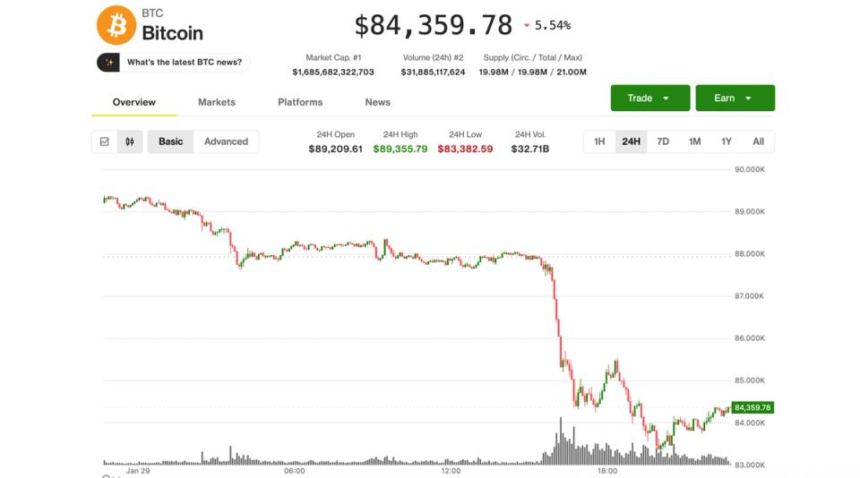
In a day marked by significant declines across traditional markets, cryptocurrency emerged as a notable laggard on Thursday. After experiencing modest declines overnight, the crypto market witnessed a severe downturn during the U.S. morning session. The Nasdaq Composite Index fell more than 2%, while gold prices plummeted almost 10% from an overnight record high. However, both markets managed to recover somewhat by the afternoon, with the Nasdaq closing down just 0.7% and gold regaining the $5,400 per ounce mark. In stark contrast, major cryptocurrencies continued to languish near their lows for the session, with Bitcoin trading at just above $84,000.
In the past 24 hours, Bitcoin has lost nearly 6%, placing it on the edge of slipping below its two-month trading range. This instability raises concerns about a potential deeper pullback in the near future. Other cryptocurrencies similarly faced declines. Ethereum was pegged at $2,818.82, while Solana, XRP, and Dogecoin reported drops of around 7%. Notably, key players in the crypto market, including Coinbase, stablecoin issuer Circle, and bitcoin treasury firm MicroStrategy, experienced losses between 5% and 10%.
Amid these fluctuations, analysts weighed in on Bitcoin’s future direction. Matt Mena, a crypto research strategist at 21Shares, highlighted the importance of Bitcoin holding above the critical support level of $84,000. Should this level fail to provide support, Mena noted that attention would shift to $80,000, where buyers had previously entered the market in November. A further dip could see Bitcoin test $75,000, a level observed during the “April 2025 tariff tantrum.” Despite these challenges, Mena remains optimistic, suggesting that current price levels present a “compelling entry point” for investors. He anticipates Bitcoin could reach $100,000 by the end of the first quarter or even soar to a record high of $128,000, contingent on favorable macroeconomic conditions.
Contrarily, some analysts cautioned against assuming an immediate rebound. John Glover, Chief Investment Officer of Bitcoin lender Ledn, articulated that the current selloff is part of a broader correction following Bitcoin’s record highs in October. He warned that this could lead to a downturn to as low as $71,000, representing a 43% decrease from the October peak of $126,000. Glover attributed the current market uncertainty largely to conditions in the U.S., prompting investors to seek refuge in alternative assets such as gold and the Swiss franc, rather than traditional safe havens like the U.S. dollar and Treasury bonds. Although many expected Bitcoin to fulfill the role of “digital gold,” Glover observed that it continues to behave more like a risk asset, moving in tandem with equities.
Echoing concerns about support levels, Russell Thompson, Chief Investment Officer at Hilbert Group, echoed Glover’s sentiment, stating that technical indicators signal a lack of support for Bitcoin in the current market environment. He indicated a potential decline as low as $70,000, acknowledging the temporary bullish prospects indicated by recent committee reports. Nevertheless, Thompson also shared Glover’s view that the unfavorable conditions will not persist indefinitely, suggesting that a rebound in Bitcoin prices may be forthcoming in the coming quarters.