









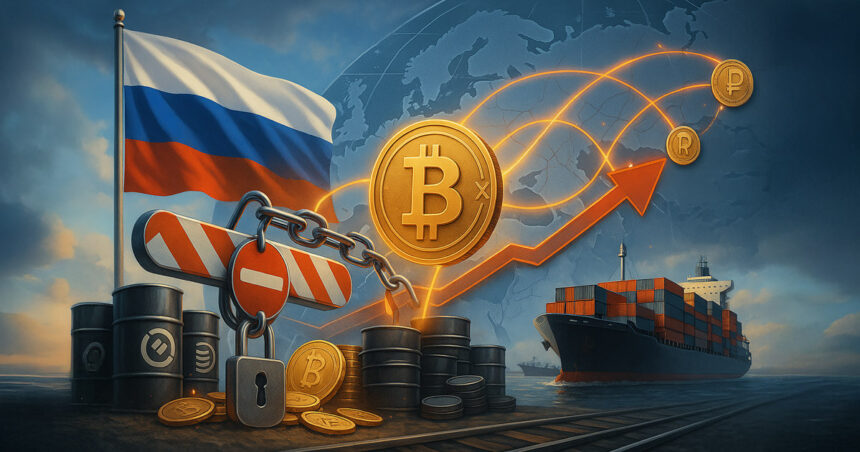
A recent report from blockchain analytics firm Elliptic has uncovered a significant network of crypto wallets linked to Russian state-affiliated entities that facilitated over $8 billion in digital asset transactions, aimed at circumventing Western sanctions. This information surfaced on September 26, following the leak of data detailing how sanctioned Russian businesses have increasingly turned to stablecoins, particularly Tether’s USDT, to continue cross-border trade operations.
Elliptic’s investigation connects many of these transactions to companies controlled by Ilan Shor, a Moldovan fugitive under U.S. sanctions and a known associate of Russian President Vladimir Putin. Reports identify that Shor has leveraged digital assets to provide financial support to Russian entities that have found themselves cut off from traditional banking systems due to international restrictions.
In a recent online conference with Putin, Shor stated that his firm, A7, had processed a staggering 7.5 trillion rubles (approximately $89 billion) in international payments over a ten-month period, with more than half of these transactions involving partners in Asia. According to Elliptic’s analysis, wallets associated with A7 have accumulated over $8 billion in stablecoin inflows in the past 18 months.
Established in 2024, A7 was specifically created to assist Russian companies in evading sanctions and carrying out cross-border financial transactions. The company is partially owned by Promsvyazbank (PSB), a Russian state bank that supports the defense sector, and both A7 and PSB are under U.S. sanctions due to their connections to the ongoing war economy.
The report sheds light on A7’s significant dependence on USDT for treasury management and payment processes, with leaked internal messages revealing an instance where an A7 employee requested the transfer of 2 million USDT, involving a wallet that had executed approximately $677 million in trades.
However, the ability of Tether to freeze wallets associated with sanctioned entities posed a challenge earlier this year. The shutdown of Garantex, a Russian exchange, led to the freezing of $26 million in USDT, prompting Shor’s network to revamp its wallet system as of August 2025. In an attempt to navigate Tether’s centralized controls, A7 started promoting its own stablecoin, A7A5, which is pegged to the ruble.
Despite these efforts, A7A5 has not gained significant traction within the market, with only $496 million in circulation and an estimated transaction volume of $68 billion. This situation underscores the ongoing complexities and challenges faced by Russian entities in maintaining access to global financial systems amid tightening sanctions.